DIE AFSTERWE VAN DIE POUS
WAAROM ONS NIE ROOMS OF LUTHERAANS IS NIE, MAAR GEREFORMEERD*
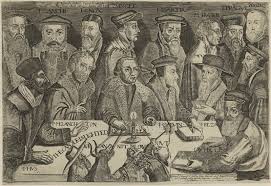
“Ek is banger vir die Pous hier binne-in my as vir die Pous in Rome saam met al sy kardinale.” –
“Yet, there is one enduring consolation – Christ is gathering His own from all races and languages, from all peoples and nations; He will bring them all together, and they will hear His voice. “And they shall be one flock, one shepherd” (John 10:16).” – Herman Bavinck
Inleiding
Met die onlangse afsterwe van die laaste pous en die verering en lofsange wat soos gewoonlik orals plaasvind, is dit goed om opnuut weer te leer en besef waarom ons nie deel is van die pousdom nie, maar waarom ons as gereformeerdes teenoor Rome se afval, vashou aan ons ‘ongetwyfelde christelike geloof’ (HK Sondag 7) volgens die Skrif alleen, soos verwoord en saamgevat in ons gereformeerde beslydenisskrifte (wat ook die vroeë kerk se ‘ekumeniese’ belydenisskrifte onderskryf, sien NGB art. 9, en daarom is ons ook ‘katoliek’, maar gereformeerd katoliek, sien NGB art. 27, “Ons glo en bely ‘n enige katolieke of algemene kerk…”).
Ek stel Bavinck aan die woord waarom die Reformasie nodig was:
Rome: The Church is the Foundation upon which Scriptures rest
First, the Catholic Church increasingly elevated tradition to an independent rule of faith alongside, above, and even against Scripture. Many Roman doctrines and practices, such as the Mass, clerical celibacy, the veneration of saints, and the immaculate conception of Mary, lack scriptural substantiation but are upheld based on tradition.
Although it is claimed that this tradition includes “what has been believed everywhere, always, and by all,” ultimately, it is the pope who decides whether something constitutes tradition.
Thus, Rome has inverted the entire relationship between Scripture and Church. In Rome’s view, Scripture is not necessary but merely useful for the Church, whereas the Church is deemed necessary for Scripture. The Scriptures hold no authority apart from the Church, which asserts their credibility; they are inherently obscure and become clear only through the Church’s interpretation; they do not precede nor form the foundation of the Church, but rather the Church is primary and is the foundation upon which the Scriptures rest.
The Pope speaks infallibly
Although the prophets and apostles were endowed with the gift of inspiration, the pope too, when speaking “ex cathedra,” in his papal capacity, is believed to enjoy special support and guidance from the Spirit, rendering him infallible. Consequently, the Church is considered self-sufficient, even in the absence of the Scriptures; it is viewed as the one true and perfect agent of salvation, possessing and dispensing all the benefits of grace through the sacraments; it is perceived as the preeminent agent of grace, the state, and kingdom of God on earth.
Rome corrupted the essence of the Gospel
Secondly, the Catholic Church has muddled the essence of the Gospel, namely, God’s free grace and the justification of sinners by faith alone, devoid of works of the law. If not wholly lost, this core has been tainted with very impure elements, thereby confounding the distinction between law and Gospel. This corruption of the original Gospel began in the early centuries but later intensified and received official endorsement.
In the struggle between Augustine and Pelagius, a battle that continues in principle to this day, the Roman Church, especially post-Reformation, has increasingly sided with the latter—not in name but in practice. While God grants the power to convert and persevere in conversion to those who hear the Gospel, the will and accomplishment ultimately depend on man.
Man must gain entry to the kingdom of God through good works. In Rome, these good works fall into two major categories: works to maintain the ordinary commandments applicable to all, and works to accomplish the counsels added by Christ to these commandments (celibacy, poverty, and obedience). The first way is good, but the second is better, more arduous, yet shorter and safer. The former is for laymen, the latter for monks and nuns. Those who tread this path of good works receive from the Church, via the sacraments, as much grace as they have earned. Ultimately, if they persevere to the end, they enter the kingdom of heaven—not at the moment of rebirth or even at death, but after years spent in purgatory.
The rise of hierarchy and Popery
Thirdly, the Catholic Church soon distinguished between clergy and laity. The clergy alone are considered true priests, not the general faithful. Furthermore, within the clergy, various distinctions arose over time.
In the New Testament, “elder” and “overseer” refer to the same ministers. However, by the second century, this unity was obscured; the bishop (episcopus, bishop) was elevated far above deacons and elders (or presbyters, priests) and gradually regarded as a successor to the Apostles and a guardian of tradition. These bishops have pastors, parish priests, and chaplains under them, with archbishops, patriarchs, and ultimately the pope above them.
The pope, officially declared infallible at the Vatican Council in Rome in 1870, represents the culmination of this extensive ecclesiastical hierarchy. He is the “father” (papa, pope) of the entire Church, the “chief priest,” the successor of Peter, the “deputy of Christ,” wielding supreme legislative and judicial power. With the support of a large cadre of officials (curia: cardinals, prelates, procurators, notaries, etc.), he governs the entire Church.
These errors, originating from minor deviations, have magnified over the centuries. They continue to evolve, transforming the ancient Christian Catholic Church into the Ultramontane, the Roman Church (inseparably tied to the Church in Rome), and the Papal Church.
In this transformation, Mary, the mother of Christ, and the Pope, the vicar of Christ, increasingly eclipse the person and work of Christ. These three errors represent a reduction of and an infringement upon the prophetic, priestly, and royal office of Christ. ….
The Reformation: the root of the Roman church problem, and the only Solution
“Furthermore, and perhaps most importantly, the Reformation, in its opposition to the Roman church, attacked the root of the problem.
It sought not merely an external improvement in forms but aimed to eliminate the very cause of the decay. For this, a fixed point of departure, a reliable yardstick, a positive principle was necessary.
This principle was found, in contrast to the traditions of the Roman church, in the word of Christ —credible in itself, essential for the life and welfare of the church, and perfectly sufficient and clear.
In contrast to the good works to which Rome bound salvation, the Reformation emphasized the perfect and all-sufficient work of Christ, needing no supplementation by human effort.
And in contrast to the pope, who claimed to be the infallible substitute of Christ, it upheld the Spirit of Christ, poured out in the church, leading all God’s children into the truth.
The Reformation did not arrive at this positive principle through scientific research and reflection, but through the experience of the guilt-laden heart, which found reconciliation and forgiveness only in God’s free grace.
The Reformation was not a scholarly or scientific movement but a religious and moral one. Many joined it, as often happens in times of division and upheaval, for impure and unjust motives; but its core was formed by the weary and burdened, who sighed under Rome’s oppression and found rest for their souls at the feet of the Holy One.
Lutheran Christianity
Luther rested in the experience of forgiveness, finding solace in discovering “a merciful God.” While this revelation granted him a more expansive view of the world than the Roman Christian, who deemed the natural inherently profane, he ultimately relegated secular matters—art, science, state, and society—to their own courses. The Lutheran Reformation thus confined itself to restoring the preaching ministry. Upon answering the question, “How does man attain salvation?” from Scripture, their efforts largely ceased.
Reformed Christianity
For Zwingli and Calvin, however, who spearheaded the reformation in Switzerland, this was merely the starting point. They too arrived at reformation not through rational argument but through the profound experience of sin and grace, of guilt and reconciliation. Yet, for them, this experience was the foundation, not the culmination.
They delved deeper and traced further back. Behind the grace of God manifest in the forgiveness of sin lay the sovereignty of God, His infinite and awe-inspiring essence with all His virtues and perfections.
– If God was sovereign in salvation, He was sovereign always and everywhere, in creation as well as in re-creation.
– If He had become King in the heart, He must also reign in the mind and hand, in the household and workplace, in the state and society, in science and the arts.
The query, “How does man attain salvation?” was not sufficient; it must be encompassed within the higher, deeper, all-encompassing question, “How does God receive His due glory?”
Hence, for Zwingli and more profoundly for Calvin, finding peace for their hearts in the blood of the cross marked the true commencement of reformation.
For them, the entire world lay open—not to be abandoned to its devices, but to be permeated and sanctified through the Word of God and prayer.
They began locally, with the church and city wherein they dwelt, restoring not only the preaching office but also worship and discipline, transforming religious life on Sunday and civil and social life during the week, influencing both the private life of the citizen and the public life of the state.
Reformation countries, the Church of Rome and many divisions
From these beginnings, their reformation radiated outward to other lands. While the Lutheran
Reformation mainly took root in Germany and the Nordic countries, Calvin’s Reformation spread to Italy and Spain, Hungary and Poland, Switzerland and France, Belgium and the Netherlands, England and Scotland, and across to America and Canada.
Had it not been for the “Counter-Reformation” led by the Jesuits, which opposed, repelled, and eradicated it in many regions, Calvin’s Reformation might well have permanently dismantled Rome’s world dominion.
It was not destined to be so. From its inception, the Reformation faced staunch opposition from the Church of Rome, which at the Council of Trent firmly set itself against the reformers and resolutely continued on its chosen path. This self-imposed opposition weakened the church through internal divisions and endless disputes.
In the same sixteenth century, Socinianism and Anabaptism emerged, both rooted in the same fundamental dichotomy — the irreconcilable opposition between nature and grace — and thus offered either grace to nature or nature to grace.
This enduring conflict between creation and re-creation, between the human and the divine, between reason and revelation, between earth and heaven, between humanity and Christianity, or however one might articulate these opposing forces, has persisted to this day.
The divisions and schisms initiated in the sixteenth century did not cease there; each successive century has witnessed an increase in their number.
The seventeenth century saw the rise of Remonstrantism in the Netherlands, Independentism in England, and Pietism in Germany. In the eighteenth century, Herrnhuttism, Methodism, and Swedenborgianism emerged, while Deism swept over all the churches like a flood.
Following the French Revolution at the dawn of the nineteenth century, a powerful religious awakening took place within both Roman and Protestant churches. Nonetheless, divisions continued to multiply: Darbyism and Irvingianism, Mormonism and Spiritism, along with a multitude of other sects, chipped away at the integrity of the churches, which themselves were often weakened and consumed by a spirit of doubt and indifference.
Worldly assaults on the Christian faith
Beyond the churches, the force of monism, in its materialistic or pantheistic forms, was organizing a final, deadly assault on the entirety of the Christian faith.
It thus appears that all hope for the unity and universality of the church of Christ is lost. Of the more than 1.5 billion people living on earth according to common estimates, there are approximately 10 million Jews, 175 million Muslims, 214 million Brahmins, 120 million Buddhists, 300 million Confucians, 140 million Shintoists, and 173 million polytheists. Christians comprise only about a third of the world’s population, approximately 534 million, and among themselves are divided into 254 million Roman Catholics, 106 million Eastern Orthodox, 165 million Protestants, along with many other groups and sects.
Our only Comfort and Hope: John 10:16
Yet, there is one enduring consolation – Christ is gathering His own from all races and languages, from all peoples and nations; He will bring them all together, and they will hear His voice. “And they shall be one flock, one shepherd” (John 10:16).
* Bron: Herman Bavinck, The Wonderful Works of God: Scriptures and Confession. Hier aanlyn beskikbaar: Monergism. Opskrifte en beklemtonings bygevoeg.
_____________________________
Verdere bronne oor die onderwerp:
a) As ‘n deeglike weerlegging van die Pousdom, sien die volgende werk van dr. JJ van der Walt:
Christus as Hoof van die Kerk en die Presbiteriale Kerkregering, Potchefstroom: Pro Rege, 1976
Veral hierdie historiese gedeelte wat aantoon hoe die pousdom gegroei en ontwikkel het deur die eeue:
3.2 Die Roomse stelsel – die verplasing van Christus as Hoof, deformasie (bl. 99-109), asook die Reformasie se antwoord op die Pousdom (bl. 110 en verder)
‘n Paar aanhalings:
“Terwyl die gelowiges steeds meer en meer ontmondig is, het die ampshoogheid steeds meer ingeskuif tussen Christus en Christen, en het die oorheersende gesagsuitoefening deur die ampsdraers tegelykertyd toegeneem: terselfdertyd het
binne. die ampskring ‘n hiërargie ontwikkel waardeur uit eindelik die pous in die Roomse kerk as “hoof”van die sigbare kerk nie net plaasvervanger van Christus, die Hoof, geword het nie, maar verplaser. In één proses is die kerkbegrip gewysig, die gelowiges ontmondig en die ampsgesag “verskerp tot ‘n heerskappy oor die gemeente.”
“Die sentralisasie van die kerk is verstewig, die hiërargie sterker uitgebou, die regte van die gemeente as gelowiges het verlore gegaan in ‘n kerk waar Christus, die enigste Hoof, uit die oog verloor is en meer gelet is op krag van die organisasie, as op die openbaring in die Nuwe Testament. In die vierde eeu het die biskop van Rome algemene erkenning gekry, en niemand het meer getwyfel dat gemeenskap met en onderwerping aan Rome noodsaaklik is nie.”
“Naas die identifisering van die Roomse Kerk met die koninkryk van God het ‘n tweede idee gedurende die Middeleeue
sterk op die voorgrond getree, naamlik die primaat van Rome. Die vyandskap van die wereld het die noodsaaklikheid van
die eenheid van die kerk beklemtoon. Die verwesenliking van die· eenheid is met steeds groter krag gesoek in die
kerklike organisasie ‘aan het hoofd waarvan de metropolieten stonden.’
“Die ontwikkeling van die leerstuk van die onfeilbaarheid van die pous het Christus in nog meerdere mate as Hoof van
die kerk verdring. Aanvanklik is die klem gelê op die kerk te Rome, wat nie van die waarheid kan afdwaal nie, omdat dit deur Petrus en Paulus gestig is en deur hulle wettige opvolgers kragtens apostoliese suksessie gelei is. In die loop van die geskiedenis sou egter blyk dat die apostoliese suksessie nie genoegsame waarborg is nie, veral toe verskeie kerke, ondanks hulle stigting deur apostels, met biskoppe en al, afvallig geword en verdwyn het. Gevolglik is die klem vir die onfeilbaarheid van Rome verlê van die primaat van die kerk na die primaat van sy hoof, die pous. Hy sou die opvolger wees van Petrus wat ‘n besondere gawe van die Heilige Gees deelagtig was.”
Bonifatius VIII sou in sy Unam Sanctum (1302) saamvat wat baie pouse geleer het…. Hiermee het die dogma van die pous as hoof van die kerk sy toppunt bereik. Die één kerk het maar één hoof. Die kerk van Christus het kerk van die pous geword. Hy is ‘die onfeilbare bron van alle dogmata, die onweerspreekbare wetgewer, die eienaar van die kerklike goedere, die hoof van die clerus, met die ander biskoppe tot sy onderhorige helpers wat hy met mag beklee. Hy is die middelaar tussen God en die mense, sonder wie se priesterlike bediening van die ganse menslike bestaan onder sy beheer betrek. …
Die Christen het sy vryheid aan die heerskappy van die pous prysgegee. En die kerk het sy wese kwytgeraak. Dit is onder heerskappy van die pous nie meer ‘n vergadering van gelowiges in Christus wat vashou aan hul Hoof nie, maar ‘n aardse ryk onder ‘n hiërargiese gesagstruktuur met ‘n menslike hoof beklee met absolute superioriteit. Die Woord van God, die Stem van die Goeie Herder, het sy gesag voor die onfeilbare pous verloor.
Die Vleesgeworde Woord, die Hoof van die kerk, is veraards ‘in die getranssubstansieerde offerande deur die pous (of
sy verteenwoordiger). Die hemelse Hoof wat sy kerk as sy liggaam op die aarde deur sy Woord en Gees regeer, is deur ‘sy plaasvervanger’, die pous, as hoof van die Roomse Kerk, verplaas tot die onwerklikheid, die misterie, die onsigbare. Op sigbare wyse en in die gewone gang van sake bestuur Christus sy mistieke liggaam deur middel van sy plaasbekleder
op aarde”.
Die sigbare hoof wat Christus aan sy kerk nagelaat het, was Petrus, sy plaasbekleder; Apostolurum Principi wat met Christus één hoof van die kerk vorm. Die opvolger van die ‘Apostel Prins’ is die volle erfgenaam van hierdie hoofskap: saam met Christus één Hoof van die kerk. Dit is die ‘Primaat’ van die pous as die ‘Organe’ van Christus.
Aan hierdie verplasing van Christus as Hoof uit die sigbare kerk op aarde kon selfs Vaticanum II geen verandering bring
nie. Pous Paulus IV verklaar in sy toespraak van 20 Nov. 1963 dat die biskoppe van die wêreld na Rome gekom het (soos
Paulus indertyd, Gal. 1:18) ‘per videre Petrum, om Petrus te zien, de Prins der Apostelen, de ‘grondslag van Gods kerk,
haar zichtbaar Hoofd, de Plaatsbekleder van Christus, in de nederige en bescheiden persoon zijn opvolger’.
Tot op die huidige bly dus in die Roomse Kerk die pous die sigbare hoof van die kerk, één hoof met die Hoof, Hy het die Christus uit die sigbare kerk verplaas tot die onsigbare. En daarmee het die Roomse Kerk geword ‘n mistieke liggaam sonder sy werklike Hoof.”
NOTA: Hierdie boek kan ook aangekoop word by Pro Regno Boeke, R100.
b) Sien die volgende artikels en bronne om verder te lees oor die Reformasie teenoor Rome:
Die Bybelse Evangelie: verloor deur Rome, herontdek deur die Reformasie
Westminster’s Antichrist Defended
“In Are We Together? A Protestant Analyzes Roman Catholicism, R.C. Sproul takes his stand for the cardinal doctrines of Protestantism in opposition to the errors of the Roman Catholic Church. Sproul, a passionate defender of the gospel of justification by grace alone through faith alone in Christ alone, cites the historic statements of the Protestant Reformers and the Roman Catholic authorities, then references modern doctrinal statements to show that the Roman Catholic Church has not altered its official positions. In light of this continuing gap, he writes, efforts by some in the evangelical camp to find common ground with Rome on matters at the heart of the gospel are nothing short of untrue to biblical teaching. In Sproul’s estimation, the Reformation remains relevant.”
Roman Catholicism’s Recent Claim That It Is the True Church
Acts of the Council of Trent with the Antidote, John Calvin
Verdere bronne oor die Hervorming
c) Vir ‘n baie deeglike weerlegging van Rome se siening dat Petrus die eerste pous was (met ‘n beroep op veral Matt. 16:18):
– J. Calvyn, Institusie van die Christelike Godsdiens, deel IV, hoofstuk 6 (Die primaat van die Roomse setel) en 7 (Die begin en groei van die Roomse Pousdom)
– Francis Turretin, Institutes of Elenctic Theology. volume 3 (P&R, 1997), Seventeenth Question: The Primacy of Peter – Was Peter an ecumenical pontiff and the head of the church and the vicar of Christ? We deny against the Romanists, p. 155-199.
– The Church Fathers’ Interpretation of the Rock of Matthew 16:18
– Heidelbog recommended sources: Roman Catholicism
Resources On Roman Catholicism
Video om te kyk: An Earnest Plea to Roman Catholics
_______________________________________
Verdere Pro Regno artikels van of oor Bavinck
Meer oor Bavinck: The Bavinck Institute
Reformed Forum: Bavinck
 PRO REGNO
Leave a comment