THE FUTURE OF ISRAEL IS DIFFERENT THAN THE FUTURE OF ZIONISTIC JUDAISM
“Brethren, my heart’s desire and prayer to God for Israel is that they may be saved. 2 For I bear them witness that they have a zeal for God, but not according to knowledge … 25 For I do not desire, brethren, that you should be ignorant of this mystery, lest you should be wise in your own opinion, that blindness in part has happened to Israel until the fullness of the Gentiles has come in. 26 And so all Israel will be saved, as it is written: “The Deliverer will come out of Zion, And He will turn away ungodliness from Jacob; 27 For this is My covenant with them, When I take away their sins.” (Romans 10:1,2; 11:25-27)
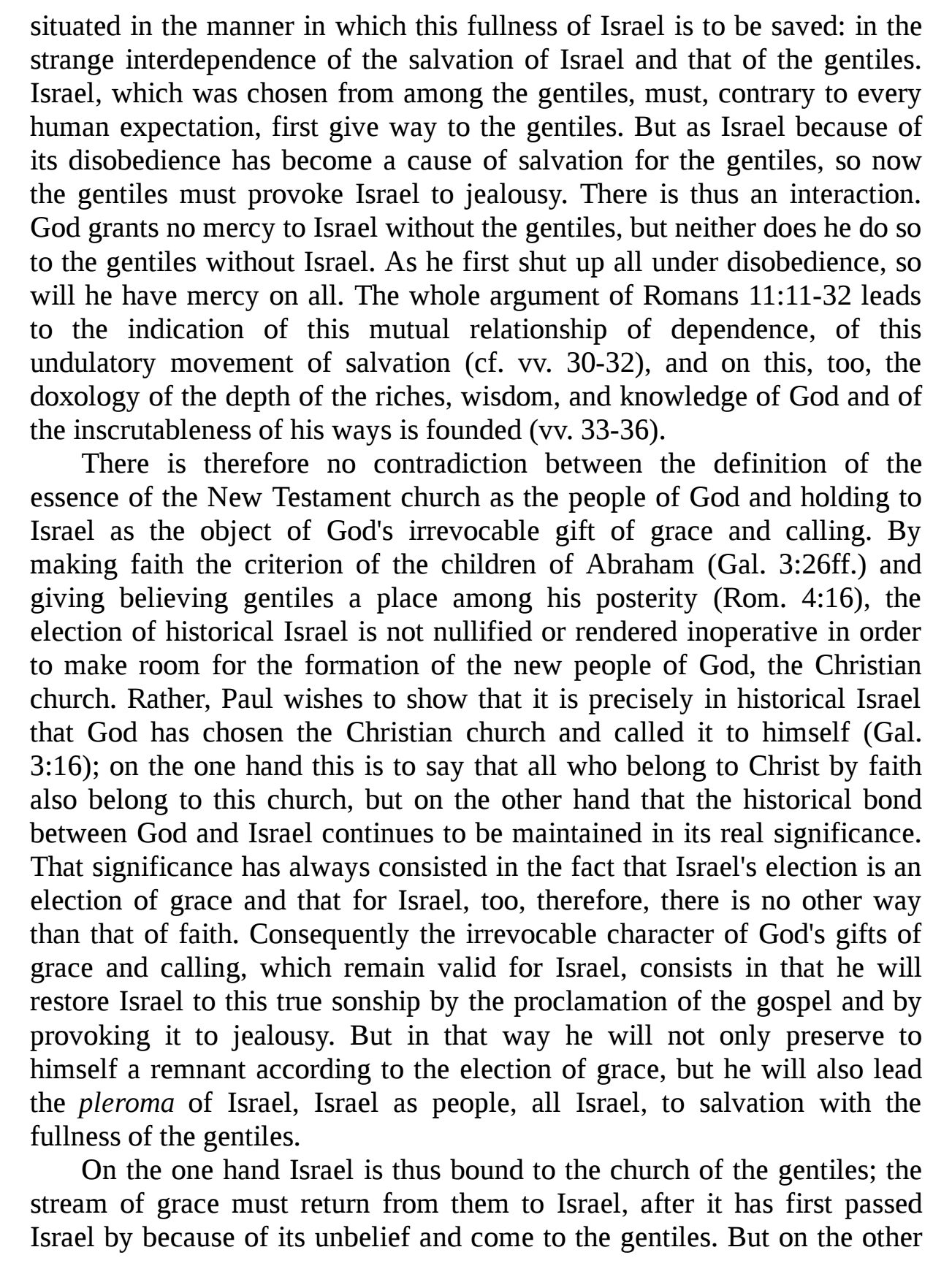
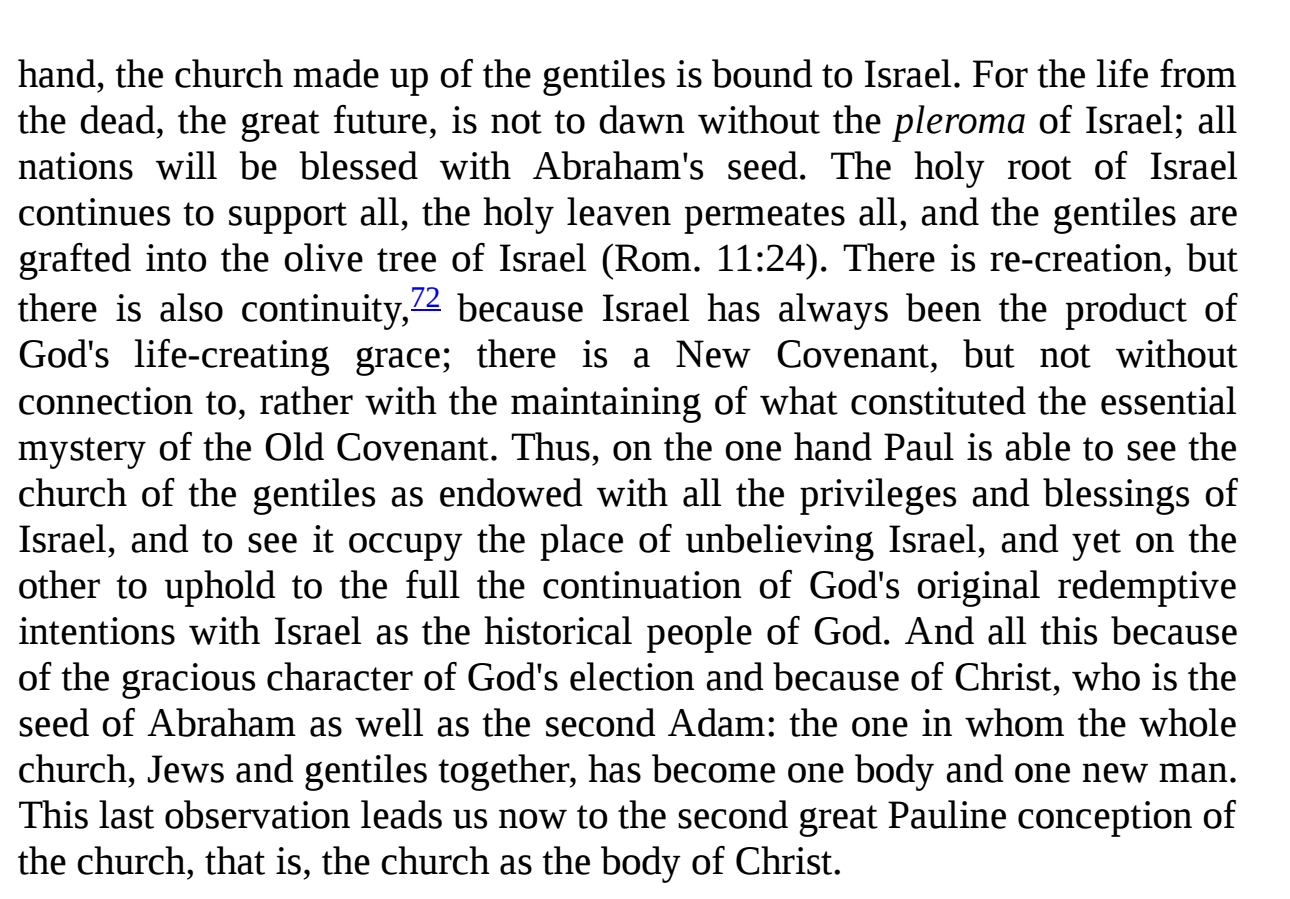
“There is therefore no contradiction between the definition of the essence of the New Testament church as the people of God and holding to Israel as the object of God’s irrevocable gift of grace and calling. By making faith the criterion of the children of Abraham (Gal. 3:26ff.) and giving believing gentiles a place among his posterity (Rom. 4:16), the election of historical Israel is not nullified or rendered inoperative in order to make room for the formation of the new people of God, the Christian church. Rather, Paul wishes to show that it is precisely in historical Israel that God has chosen the Christian church and called it to himself (Gal. 3:16); on the one hand this is to say that all who belong to Christ by faith also belong to this church, but on the other hand that the historical bond between God and Israel continues to be maintained in its real significance. That significance has always consisted in the fact that Israel’s election is an election of grace and that for Israel, too, therefore, there is no other way than that of faith. Consequently the irrevocable character of God’s gifts of grace and calling, which remain valid for Israel, consists in that he will restore Israel to this true sonship by the proclamation of the gospel and by provoking it to jealousy. But in that way he will not only preserve to himself a remnant according to the election of grace, but he will also lead the pleroma (fullness – slc) of Israel, Israel as people, all Israel, to salvation with the fullness of the gentiles.” – Herman Ridderbos
Introduction
There are few topics that currently spark more controversies and debates among both believers and non-believers, than the ‘future of Israel’, even more so with all the wars and struggles in the Middle-East (see also The Problem of Israel, rev. Bassam M. Madany.)
As many people, as many views and opinions.
Believers will ask the most important question: but, what does the Scripture teach about the future of Israel?
Now I have been publishing a few articles on the topic of well known theologians and commentators through history here, and also a few of my own, see here: Israel
There are so much confusion out there among churches and theologians these days, that in debates many miss each others arguments ‘for and against’ Israel, that it ends in the ‘Label wars’: “You are a Zionist!… you are anti-Semitic!” … and everything between, which are both funny and sad at times.
But, what does the Bible teach about the future of Israel, and related big questions: did the Church replace Israel, and if it did ‘how’, and if it did not, ‘how’ should we correctly understand the right biblical God-glorifying-loving-all-nations-for-Christ-sake way to pray for the ‘future of Israel’, and, all nations, that God be glorified alone? Did God work with ‘nations only in the OT’, and in the NT with only individuals, does God’s redemptive work through Christ alone, destroy nations as such, leaving only the ‘instituted church’, or does God’s grace, like Bavinck would say, restore nature, He worked with both ‘individuals and nations’ in the OT, and in the NT even more so with both: nations are saved in their elect in Christ alone (Eph. 1:4) among all the nations and languages through history? (See more about that here: Bavinck se allesomvattende gereformeerd-verbondmatige sendingvisie: moet sending begin met individue of volke? English: Bavinck’s all-encompassing Reformed-covenant mission vision: should mission begin with individuals or peoples?)
Now, the confusion and debates are also among Reformed believers and churches today, who takes covenant vs dispensational theology very seriously (relation OT – NT, both continuity and discontinuity, law and gospel, promise and fulfillment, etc.), but even among reformed covenantal believers there are strong disagreements about this issue.
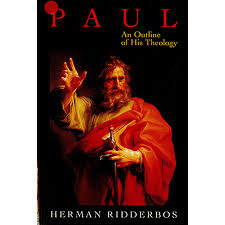
I therefore want to recommend to all believers, especially reformed believers, to read and study Herman Ridderbos’ work: Paul – An Outline of His Theology, which is a classic work in itself in the ‘Kingdom revelation-history, redemptive historical, the already not yet’ theology and hermeneutics tradition.
[Pro Regno Boeke: Ridderbos book available, 2nd hand copy: R350-00]
On our topic, see chapter 8 of his book: “The Church as the People of God”, and then especially:
(56) The New Covenant, Universal and Particular
(57) The Nature of Election, God’s Purpose
(58) The Future of Israel
Now it seems that there were two Ridderbos views on the ‘Future of Israel’, the earlier version as can be read below in his work about Paul, and, then the latter Ridderbos, that are different, and can be read in his Romans commentary, Aan de Romeinen, from which Romans 11 a few parts were translated by GP Waters and RB Gaffin Jr., and available here to read:
Herman Ridderbos and Romans 11 – Two New Translations
Waters and Gaffin writes:
“To introduce these two pieces and to place them in context, it is helpful to survey three leading interpretations among Reformed interpreters of “all Israel” in Rom 11:26 (“And in this way all Israel will be saved”). First, Calvin, like Augustine before him, understood “all Israel” to consist of the entirety of the people of God, Jew and gentile, at the consummation. Second, many Reformed interpreters understand Paul to be speaking of a mass conversion of Jewish persons who happen to be living immediately before the return of Christ at the end of the age. Third, other Reformed interpreters read Paul to be speaking of the totality of elect Jews throughout history, viewed from the perspective of the consummation.
It is this third view for which Ridderbos vigorously contends. Ridderbos acknowledges in his 1955 essay on Romans 9-11, authored four years before he published Aan de Romeinen, that, in his day and context, “the great majority of recent exegetes” understand Rom 11:26 to refer to “a great religious revolution … consisting of the conversion of Israel as a whole at the end of the days.” He confesses that “under the influence of the current exegesis, initially I too was of this opinion,” but that he has subsequently come to reject it. He maintains that neither Rom 9-11 as a whole nor Rom 11:25-26a particularly affords any exegetical basis for the “conversion of all Israel after the fulness of the gentiles has entered,” that is “in post-history.” “All Israel,” rather, “is the full number of those who in the course of history, in conformity and together with the true Israel of the old day, have repented before God, have believed in Christ, and have understood and accepted the true nature of Israel’s election: not by works but on account of the righteousness which is given by God.”
I myself are open to all three reformed views, but still more convinced of the older or earlier view of Ridderbos, i.e. the second view mentioned above, we must study prayerfully further on the topic (Acts 17:11).
But for now, let’s hear what Ridderbos say in the beginning of (56) Ridderbos, as he writes:
“The significance of the church — which has repeatedly come to light in the foregoing — as the continuation of Israel, as the elect, called, holy people of God, ought now to be defined further according to its content and essence. We have already seen in the analysis of these various designations that this “continuation” is no simple matter. On the one hand, in a positive sense it presupposes that the church springs from, is born out of Israel; on the other hand, the church takes the place of Israel as the historical people of God. This means a new definition of the people of God, and likewise a new concept of Israel. The question is how one is to conceive of this redemptive-historical transition, on the one hand with regard to the historical Israel of the Old Testament that God has chosen to himself and to which he has given his promise, on the other hand with regard to the unbelieving Israel that has rejected Christ and thus placed itself outside the fulfillment of the divine promises to Abraham and his descendants.
Paul himself is occupied with this matter time and again and in various contexts in his epistles. Three different points of view admit of being clearly distinguished in them:
(a) In the foreground is the new — new, that is to say, as given with the revelation of Christ — definition of the essence of the people of God, which may be expressed as well in terms of the New Covenant.
(b) This new definition at the same time represents the real nature of Israel’s election and the content of God’s purpose with respect to his people.
(c) This new definition does not exclude continuing concern with historical Israel; the latter, even in spite of its unbelief, as the once chosen people of God remains involved in the fulfillment of his promises.”
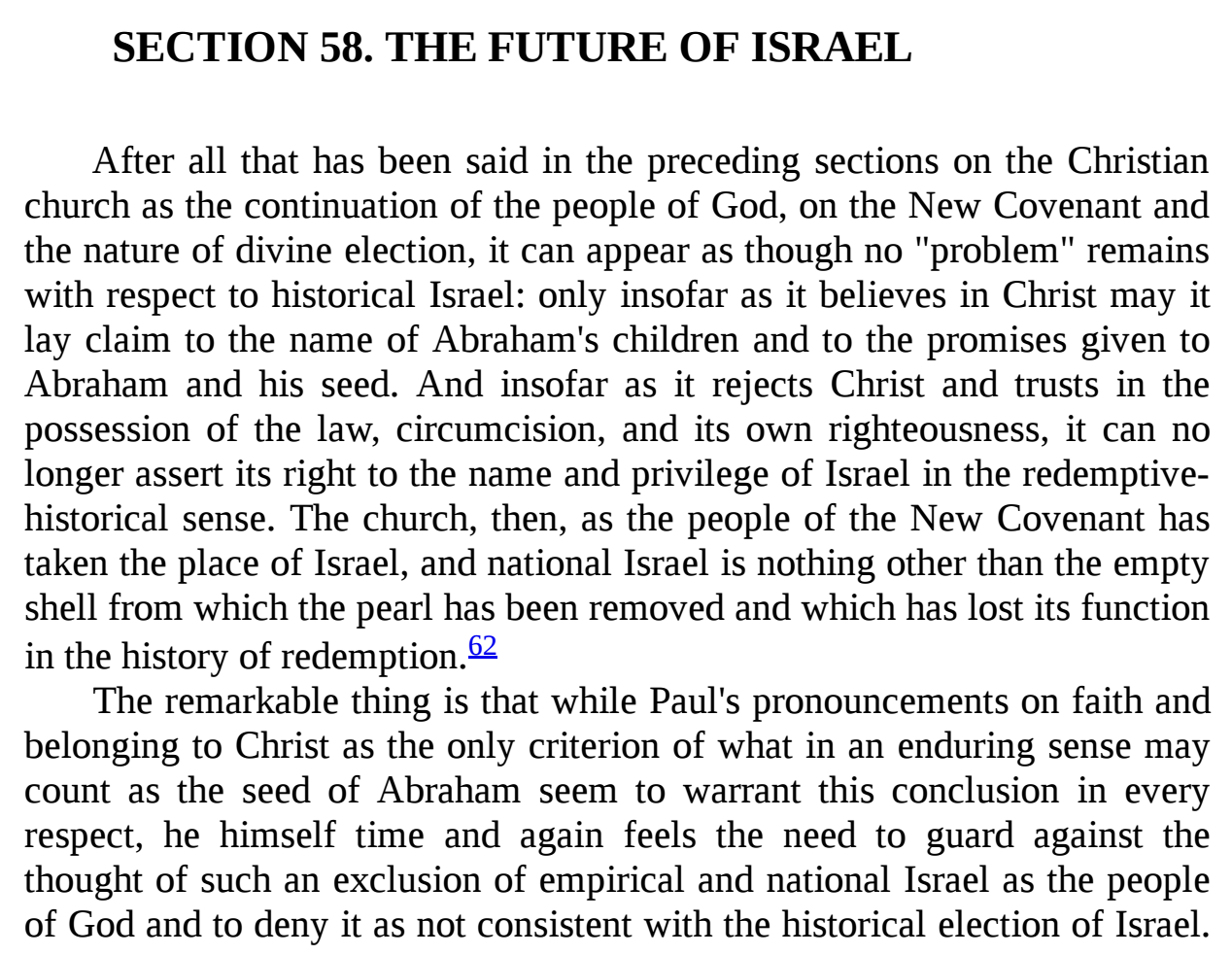
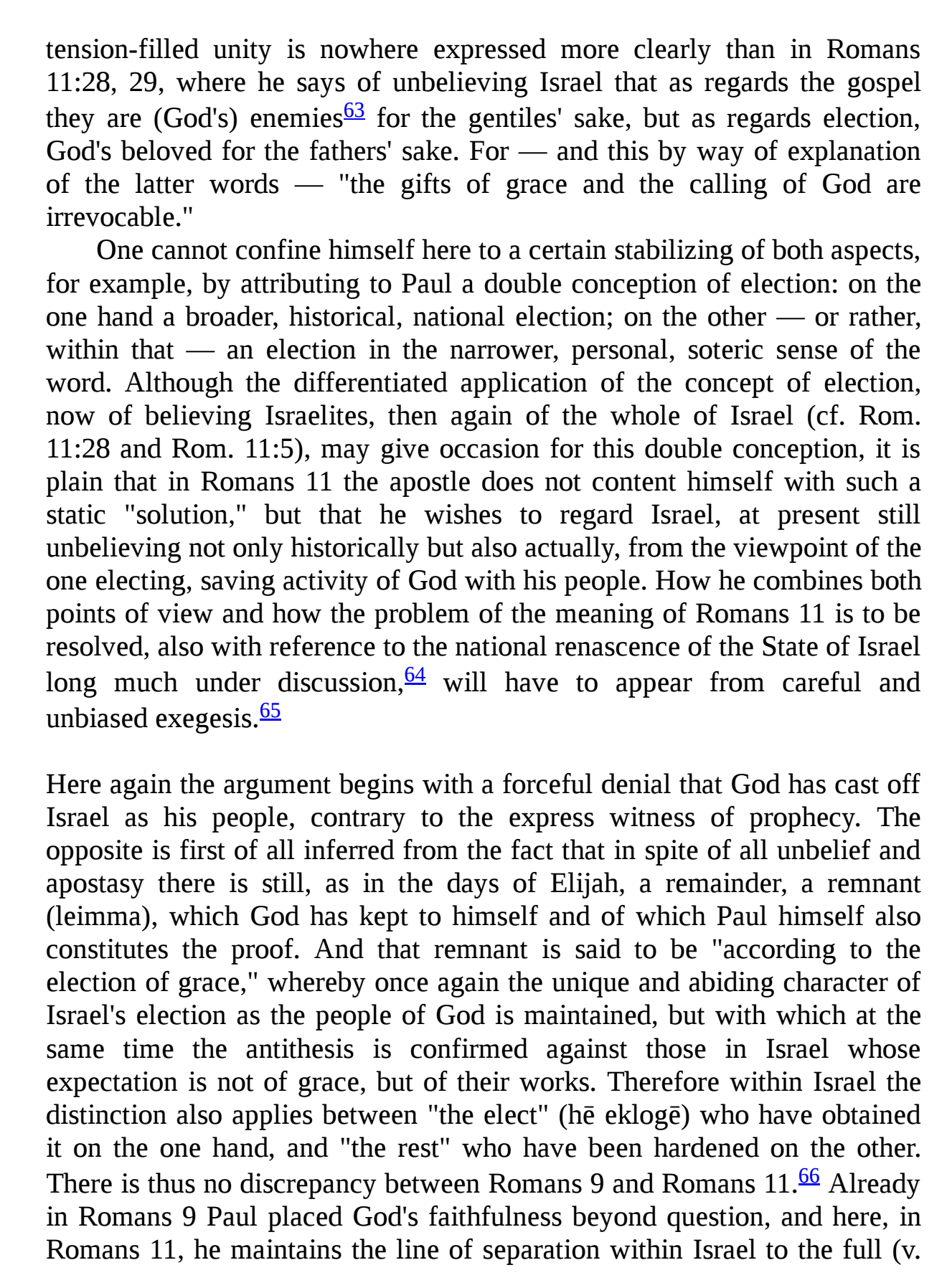
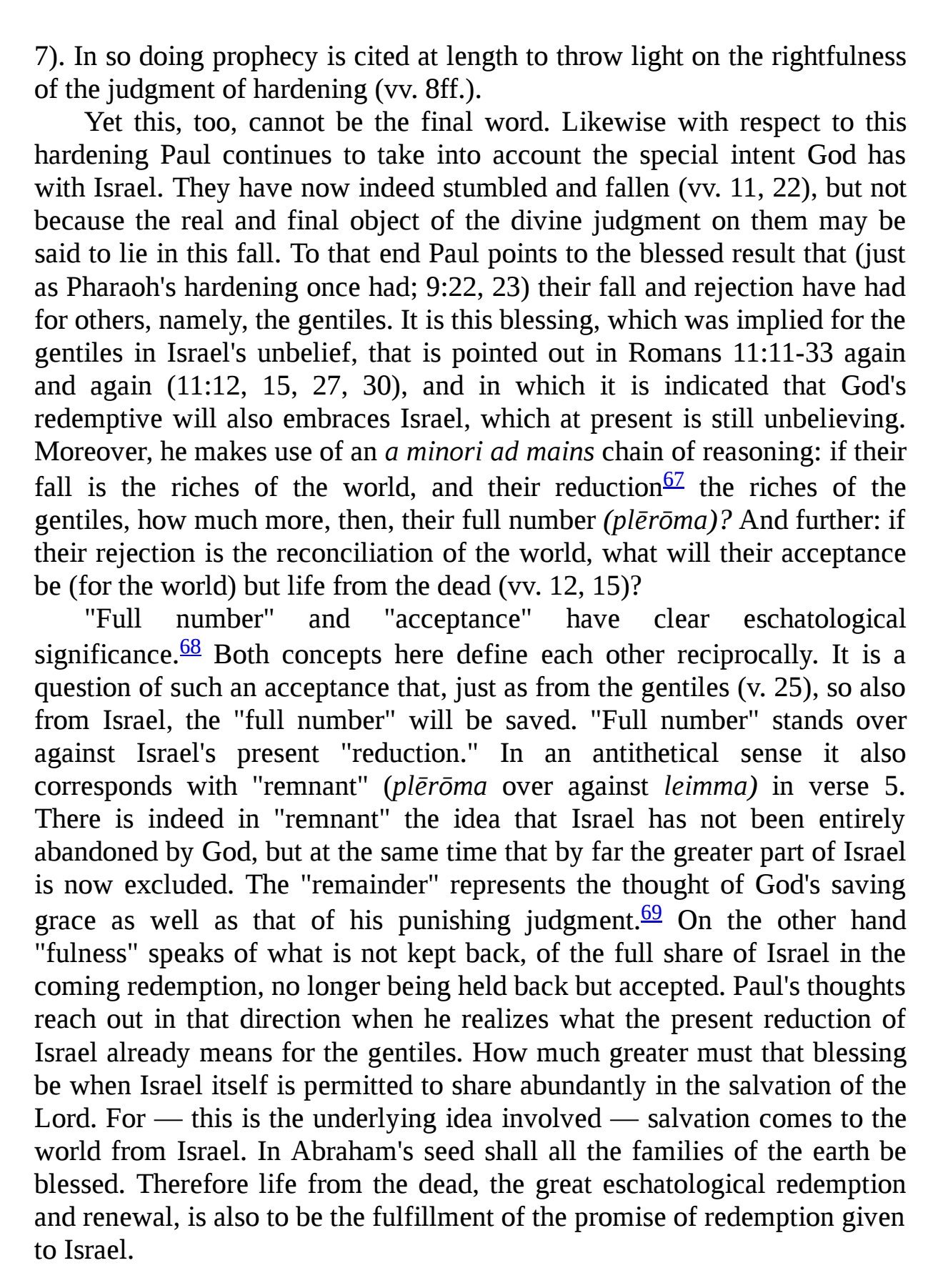
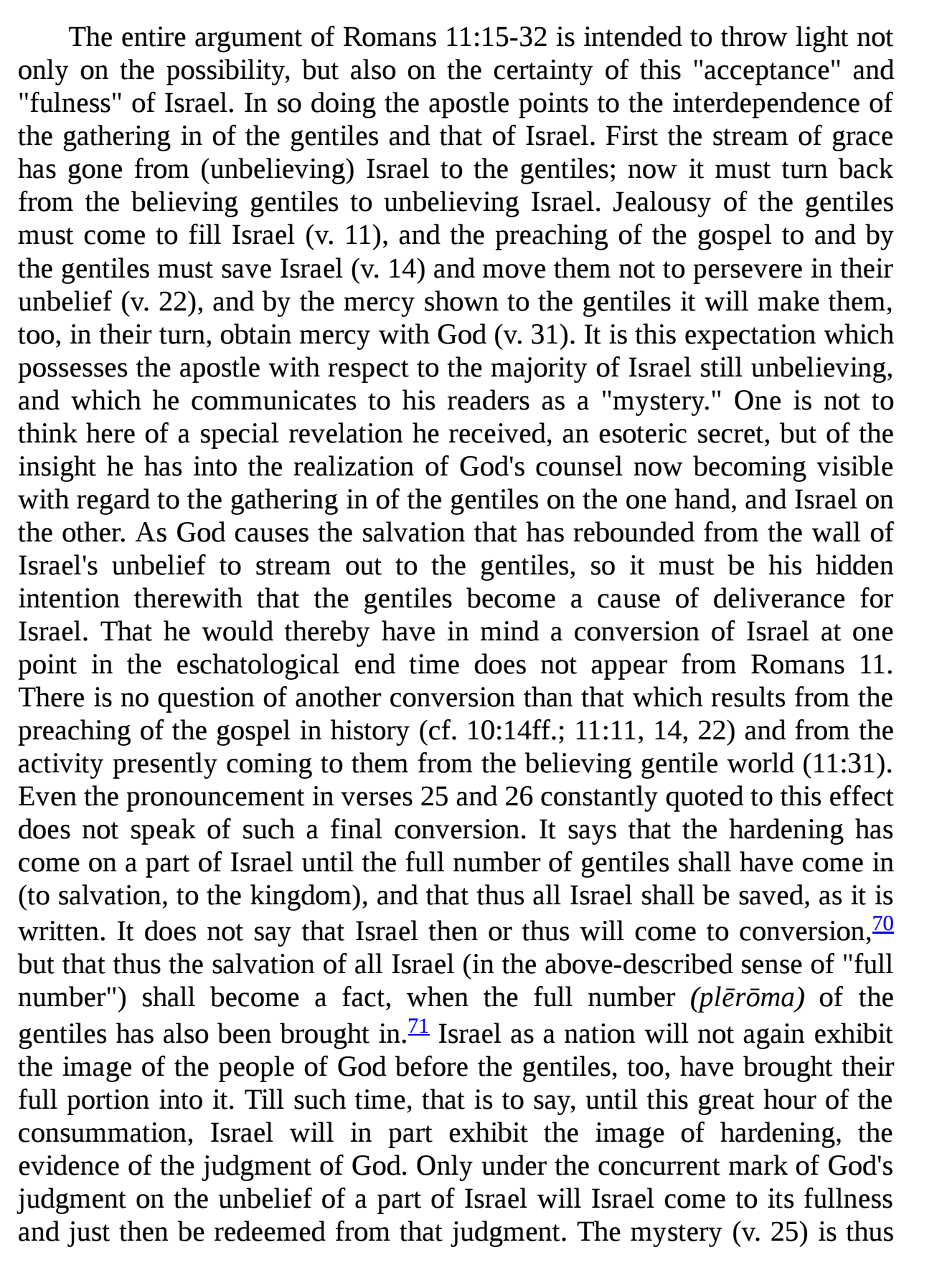
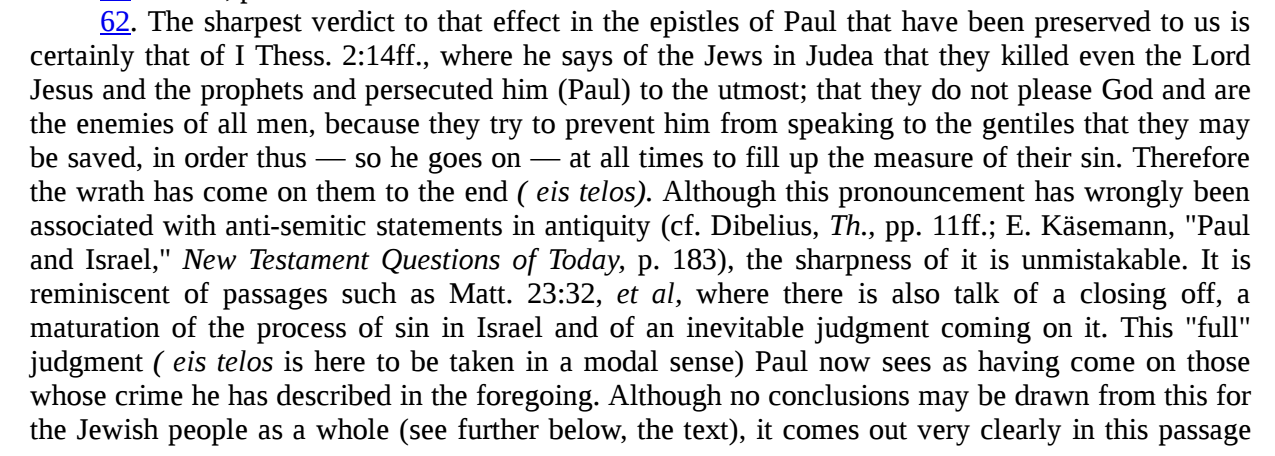
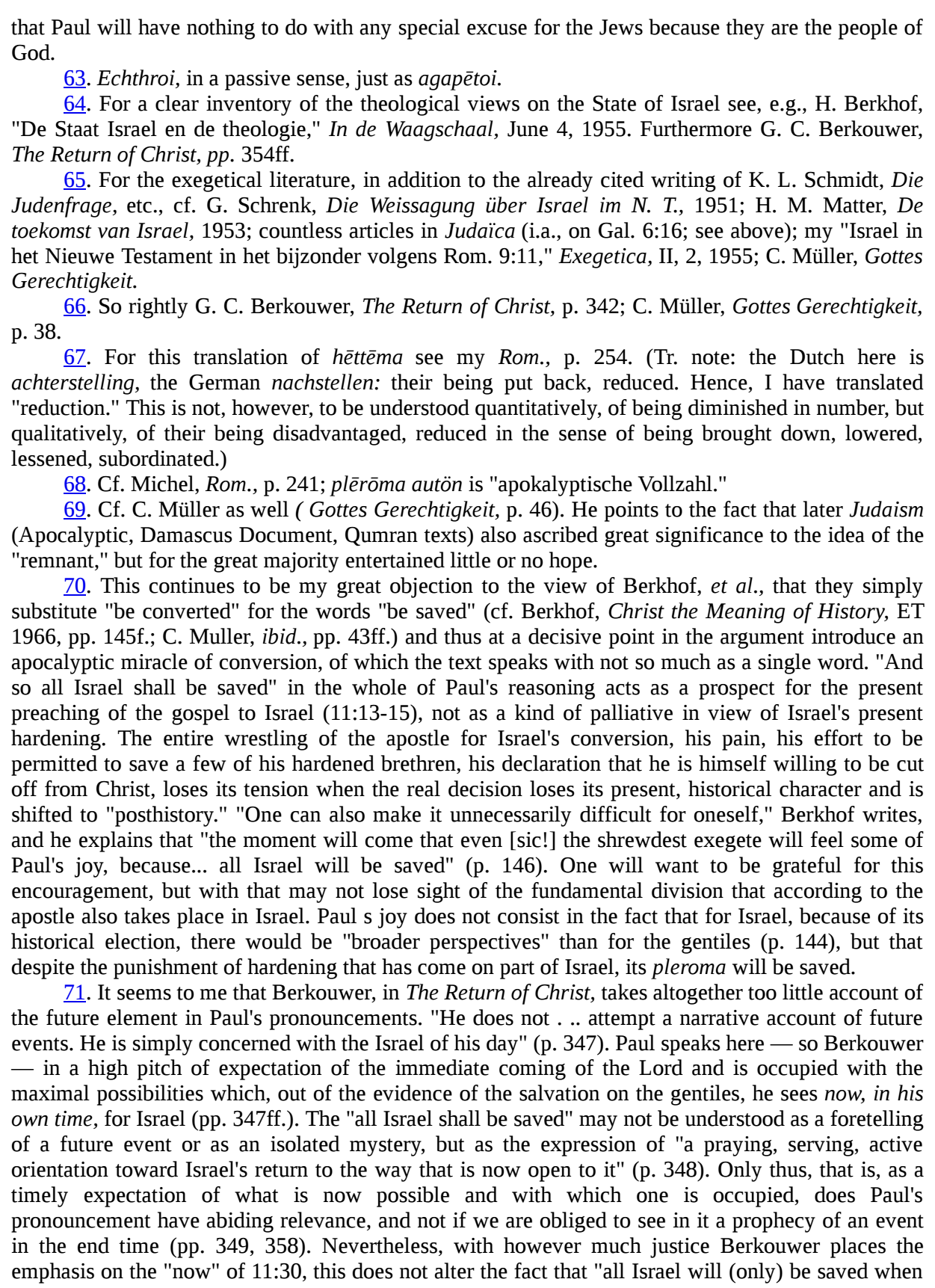
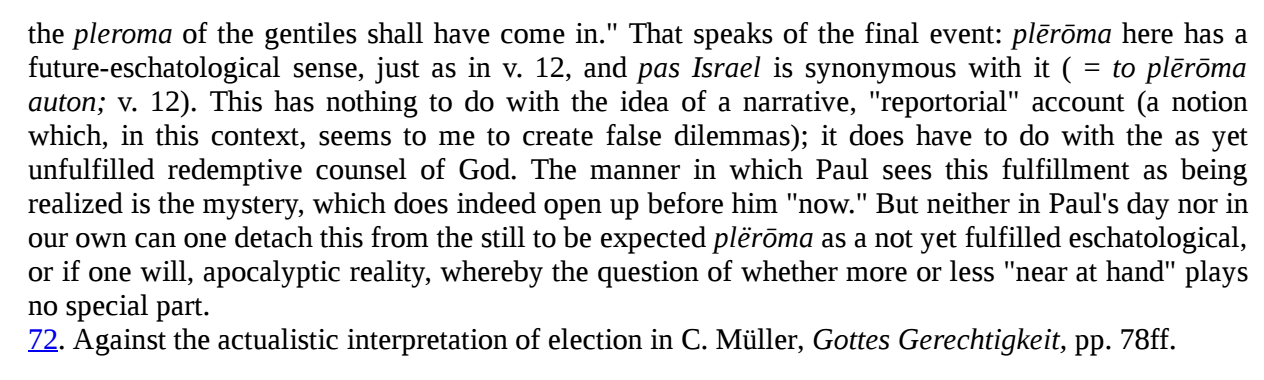
Acknowledging the source (Paul: An Outline of His Theology, Eerdmans, 1975: 354-361), below you will find a part of his discussions (58) of these very important aspects, as he gives very good insights into Romans 9-11, answering the question of the ‘Future of Israel’, may it help all believers and churches to pray and think biblically about this important topic also for our times:
__________________________________
DIE SeëN van Abraham (Gen. 12:3) is Jesus Christus vir alle volke deur die geloof alleen, nie Judaisme of enige ander volk, mens, kerk, politieke of ekonomiese leier, tradisie of groep nie
Herman N. Ridderbos se verklaring by Gal. 3:7,8,14,16,28, 29 (waarin redding deur genade alleen, deur die geloof alles bepalend is, maar nie volke vernietig nie, maar red en heilig in hul uitverkorenes. Dus, ons verwerp ‘vervangingsteologie’ [wat basies leer dat in NT verwerp God en werk net met individue], maar handhaaf ‘vervullingsteologie’ [dus, dit gaan daaroor dat God sy geestelike saad onder al die fisiese saad of volke red, dus volke word organies-verbondsmatig gered in hul uitverkorenes. Die verandering van OT na NT, was nie van ‘volk of volke na die institusionele kerk’ los en in stryd met die volke nie, maar ‘van die Here se kerk onder een volk, na die Here se kerk onder alle volke, stamme, tale en nasies. Dus een kerk onder en in alle volke, Matt. 28:18-20; Luk. 2:32; Hand. 2:8; Rom. 11:25,26; 15:8-13; Op. 5:9):
(7) The conclusion which Paul draws in this verse from Gen. 15 is presented to his readers as something plain and irrefutable, and as one which they must now once and for all make their own. This conclusion concerns the question, Who are children of Abraham? It may be that the Judaizers had also operated with this question. After all, the promise was to Abraham’s seed (Gen. 17:7). Paul points out that this descent from Abraham is not determined by physical descent, nor by circumcision, but by spiritual kinship with Abraham. What matters is the inner oneness. They that are of faith: the people who believe, the believers—they are kin to Abraham (cf. 2:12). Faith is therefore the criterion for being sons of Abraham.
The statement is emphatic: the same are the sons of Abraham. In this verse Paul maintains to the full the unity of the old and new covenants. The promise made to Abraham still holds. The method by which it is obtained is faith. The fact that natural descent and being incorporated into Abraham’s seed by circumcision also has its significance does not come into consideration; elsewhere it is expressly acknowledged, also by Paul (Rom. 9:4; cf. Acts 2:39). But not by this is the true covenant-community determined, and the Galatians must come to acknowledge that.
(8) Paul goes a step further. He says that kinship with Abraham, and the blessing connected with it, depends on faith, that therefore the Gentiles can share in it, and—this is the further step—that this can not only be indirectly inferred from the Scripture, but is expressly stated in it. The scripture is personified at this point. Really God Himself is being designated, for His word to Abraham is cited, and His foresight determined this utterance. It is Scripture, however, which, so to speak, preserves this word of God alive and makes it available.
The apostle is alluding to the blessing of God pronounced upon Abraham in Gen. 12:3. When this pronouncement came to Abraham the blessing itself was still quite entirely a future matter. And the way in which it would be realised, namely, the way of justification by faith, was not yet visible. Still, it all lay contained in the word of God addressed to Abraham, as is now (Paul means to say) evident. Nor was this accidental. It was the divine foreknowledge that accomplished this.
Paul finds these things designated in the words: in thee shall all the nations be blessed. Plainly the sharing of all the nations in Abraham’s blessing cannot be based upon biological relationship with him. Hence the apostle sees the evidence in these words of the fact that the Gentiles will be saved in the way of faith. One can ask; of course, to what extent this meaning was also in the mind of the writer and the first reader of the Book of Genesis. But the main thing remains what the Scripture, as the Word of God, intended. And this becomes evident in the fulfillment of God’s revelation and promise as pointed out by Paul.
The promise made to Abraham is here qualified as being the gospel. The citation itself is a combination of Gen. 12:3 (cf. Gen. 28:14) and Gen. 18:18 (cf. 22:18 and 26:4). The blessing in question here does not affect material welfare only but also the whole curse which lies upon the human race. In Abraham this curse will be lifted from all mankind.”
(14) In this verse, the apostle returns to the point of departure of his argument: the gift of the Holy Spirit, accruing also to the Gentiles, as a product of the blessing given to Abraham. All this has become possible in Christ, through His self-surrender. In two final clauses Paul sums this up as the conclusion of what has gone before. The second “that” is to be regarded as coordinate with the first. The second clause in another way says the same thing as the first clause. “The promise of the Spirit” is metonymy for the promised Spirit (cf. Luke 24:49, Acts 1:4; 26:6, and Heb. 9:15). The gift of the Spirit is now designated as the content of the promise to Abraham.
It is the guarantee or pledge of the perfected redemption which Abraham was promised. And all through faith, that is, by way of a believing appropriation of the preaching (cf. verse 2), and quite without merit of works. At bottom faith, too, is fruit of the work of the Spirit (cf. Eph. 2:1, 5, 8 and Col. 2:13). At the same time this faith is the means by which, and the way in which, God grants the gifts of the Spirit to the redeemed by Christ.
(16)…. From the very beginning, that is, when God spoke to Abraham, a distinction was made between seed and seed. In fact, before the birth of Isaac, God had told Abraham that not in Ishmael but in Isaac should his seed be valid. This could serve, therefore, to teach Abraham how he had to regard the seed of the promise (cf. Gen. 17:19–21, 21:12). And this consideration could also give Paul occasion to explain that the concept seed is not to be taken as an indiscriminate quantity but as a unit (concentrated in the person of Christ).
Objectively, therefore, the basis of Paul’s distinction between the one and the many is contained in God’s address to Abraham. And it is, what with the use that Paul makes elsewhere of this datum (cf. Rom. 9:7), very probable that this constituted the occasion for his pointing to the use of the singular, applied as it is to the person of Christ. If, consequently, we can say that Paul’s exegesis of seed has its substantial basis in the differentiation between Isaac and Ishmael, issuing in Christ—that is in the history of the covenant in the promise—still, this does not deny that, linguistically, he finds the expression of it in the singular of the noun. And it may be true that this singular, taken by itself, need not designate a single person, and that the bearing of the passages concerning it in Genesis also is not restricted to one person. But this need not keep us from seeing in the singular seed an indication of Abraham’s descendants concentrated in one definite person. For, from the vantage point of the fulfillment we take this seed to be Christ, and it is from that vantage point also that Paul is looking. The word used here can in both the Hebrew and the Greek be used to designate one definite descendant. That Paul is thinking inclusively, not exclusively, is clear enough from what follows. Just as in Genesis 21:12 the person of Isaac is designated by the word seed in distinction from that of Ishmael, though not, of course, by exclusion of Isaac’s descendants, so, according to Paul, the singular of the noun is also a designation of the one Christ in distinction from all other indiscriminate descendants of Abraham together, but not in exclusion of those who are bound with Christ by faith (cf. verses 26–29).
(28) Now the ye all of verse 26 and the as many of you of verse 27 are more particularly explained. In Christ there is no descent, rank, or sex. The first contrast which Paul sets up, there can be neither Jew nor Greek, is to be taken in a religious rather than a national sense. The gulf between these two was regarded as being so fixed and wide, not because the Gentile belonged to another nationality, but because he was uncircumcised and therefore was not an heir of Abraham. Now Paul says that this gulf does not exist in Christ but has been bridged in him. He is the seed of Abraham, and faith alone is necessary to share in the benefits of that seed.
Two further sets of contrasts are added to this one, both of them referring to the tremendous separation which social inequality and the differentiation of sexes brought with them in ancient times. True, it is the religious contrast that is the bone of contention between Paul and his opponents, but the oneness of master and slave, too, and the oneness of man and woman, in Christ, illustrates how completely the bond with Christ conquers all things and establishes them, also the removal of the first opposition (cf. 6:15, 1 Cor. 12:13, Col. 3:11).
This is not to maintain that the natural and social distinction is in no respect relevant any more (cf., e.g., Eph. 6:5, 1 Tim. 6:1, Titus 2:9, 1 Peter 2:18, 1 Cor. 11:3 ff., 14:34 ff., and 1 Tim. 2:11 ff.). From the point of view of redemption in Christ, however, and of the gifts of the Spirit granted by Him, there is no preference of Jew to Greek, master to slave, man to woman. This has social consequences, too, although the apostle does not enter further upon them at this point.
The final clause speaks positively and very emphatically of the oneness of all in Christ. And it is in this way that the sense of the first clause becomes entirely clear. Only the person who knows who Christ is, what He has done and is still doing, can understand how and in what sense those oppositions are obliterated. Ye are all one: that predication stands without the addition of “body” or “temple” at this point. The point at the moment is the idea of oneness.
(29) This verse draws the conclusion and calls the attention back to the beginning of the argument where Paul called the believers the seed of Abraham (verses 7–9) to whom the promises were spoken (verse 16). Now he can postulate this with even more force, now that he has spoken of being one with, and belonging to, Christ of all believers. If so, they also belong to the seed of Abraham, and consequently are heirs according to the promise. According to the promise: that is, according to the nature of it, not by works of the law, but by the gracious and effectual word of God. Heirs, originally thought of in connection with the right to the land of Canaan given to the seed of Abraham, and now comprehensive of the history of salvation in general. With this last link in the chain, it becomes clear in what sense Christ could be called the seed of Abraham (verse 16): in a corporative sense, that is, as Head of the body and of the new covenant.
Always and again this one thing is reconfirmed: that belonging to the seed of Abraham is not determined by physical descent, but by faith. Essentially, in principle, the seed of Abraham is spiritual seed. If on the one hand this represents a limitation of the concept, on the other it represents a tremendous broadening of it. It is this broadening of the concept of Abraham’s seed that is the subject in this context.
Bron: The Epistle of Paul to the Churches of Galatia (Grand Rapids, MI: NICNT, 1953).
Sien ook hierdie artikels:
The Reformed views of the future of Israel are massively different than the dispensational Zionistic Judaism views
Totius oor die Joodse vraagstuk in die lig van Gen. 9:27
More on the topic here at Pro Regno: Israel
Online works by Ridderbos: Monergism
Review of Ridderbos: Paul – An Outline of His Theology
 PRO REGNO
DIE ‘JUDAISTIESE ZIONISME’ WAT HUL SKAAM VIR CHRISTUS?
Ek sien toe hierdie YT boodskap op ‘n Joodse You Tube kanaal:
“Netanyahu Sits In Stunned SILENCE as Mike Huckabee Sends Biblical Message To The World!”
Dadelik dink ek, die ambassadeur van die VSA, Mike Huckabee, wat bely dat hy ‘n Christen is, wat ‘n baptiste predikant was voor hy in die politiek gegaan het, gaan Mark. 8:38 waarskuwing ter harte neem wanneer dit nou regtig saak maak (dink aan Paulus in Athene, ons onthou dit nou nog, Hand. 17:17-34….), hy gaan op ‘n wyse taktvolle dapper onbeskaamde wyse (soos Charlie Kirk?) hierdie wêreldwye, maar veral Joodse geleentheid gebruik om ten minste ‘n saadjie te lê van die ware Messias wat die enigste ware ‘lig van die nasies’ is, soos die OT al reeds leer en orals van getuig (Gen. 12:3; Ps. 2, 110, Jes. 52 tot 54, ens. sien veral Jes. 52:10).
Maar nee, dit gaan alles oor die roem van die mens, die Jode in hulself, in hul politiek, in wat hul reggekry het, in hulle ‘klippe, stene’, en absoluut geen verwysing of sinspeling eers na die Rots wat die Jode én almal onder alle volke wat weier om in Hom te glo, nog steeds verwerp nie (1 Pe 2:4-10).
Selfs toe Huckabee na die Nuwe Testament verwys (nadat hy na die OT verwys het, o.a. Ps. 137:5), na Lukas 19:40 van alle verse se ‘klippe wat uitroep’, het ek gedink, hier kom dit nou, dit kan mos nie anders nie, want ons lees die WIE of wat die klippe sal uitroep in vers 38 en 42-44, oor wie dit werklik gaan, soos Ps. 146:3-5 ook leer,
“38terwyl hulle sê: Geseënd is die Koning wat kom in die Naam van die Here, vrede in die hemel en heerlikheid in die hoogste hemele! 39En sommige van die Fariseërs uit die skare sê vir Hom: Meester, bestraf u dissipels! 40En Hy antwoord en sê vir hulle: Ek sê vir julle, as hulle swyg, sal die klippe uitroep. 41En toe Hy naby kom en die stad sien, het Hy daaroor geween 42en gesê: As jy tog maar geweet het, ja, ook in hierdie dag van jou, die dinge wat tot jou vrede dien! Maar nou is dit vir jou oë bedek. 43Want daar sal dae oor jou kom dat jou vyande ’n skans rondom jou sal opwerp en jou omsingel en jou van alle kante insluit. 44En hulle sal jou en jou kinders in jou teen die grond verpletter; en hulle sal in jou nie een klip op die ander laat bly nie, omdat jy die gunstige tyd toe God jou besoek het, nie opgemerk het nie.” (Lukas 19:38–44)
Ja, die enigste ware vrede, innerlik en vir die ganse lewe, is om die dinge, om Christus te omhels ‘wat tot jou vrede’ dien.
Huckabee… as belydende gelowige … kundig of onkundig … besef nie dat, as hy waarlik die Joodse volk liefhet, Israel se shalom waarlik soek, dan sal hy vir hulle vertel van die Messias, Jesus Christus, die enigste Verlosser-Koning, dit is wat alle ware liefhebbers van Israel, en van alle mense en volke doen:
“Hy het eers sy eie broer Simon gekry en vir hom gesê: Ons het die Messías gevind—dit is, as dit vertaal word, die Christus. 43En hy het hom na Jesus gelei. …. Filippus het Natánael gekry en vir hom gesê: Ons het Hom gevind van wie Moses in die wet en ook die profete geskrywe het: Jesus, die seun van Josef van Násaret.” (Joh. 1:42–46)
En nog erger, die zionistiese yweraar sê heeltemal korrek (by implikasie) dat die Christelike geloof bestaan uit beide die OT en NT, maar beweer dan dat die Judaisme oftewel die ‘Joodse geloof’ van huidige Israel, wat net die OT (en wel die verdraaide verklaring daarvan, 2 Kor. 3:14), sonder die Messias erken… dat dit vir hom goed so is en so moet voortbestaan, dus hy meen Judaisme is ‘n ware geloof, hul hoef nie die vervulling van die OT profesiee te aanvaar nie, die Christus te aanvaar nie.
Hulle hoef nie die volle Openbaring te ontvang nie, hul hoef nie die Een wat orals in die hele OT geprofeteer word, Jesus Christus te omhels deur die geloof nie… hulle kan aanhou Christus verwerp, en die ambassadeur verwelkom dit en meen verder: no one can take Israel the land again from the Jews… ek wonder: selfs nie die Here self, soos Hy reeds gedoen het in die 1ste eeu nie (Matt. 24 en 25; sien ook Deut. 32:8 en Hand. 17:26).
Natuurlik kan hy seker nie alles gesê het nie, en ek weet nie of hy meer met daardie geleentheid gesê het of op ander plek meer gesê het nie, maar wat hy wel hier gesê het… en nie gesê het nie, sê baie van die ‘Amerikaanse Zionisme’ dwaling wat tragies is, ongeag al die ander goeie dinge wat wel gedoen word om “Amerika weer groot te maak”.
In sulke gevalle wil ek amper sê, iets in die lyn van die “two kingdoms’ ideologie: as jy die Bybel so gaan verdraai en misbruik, moet dan eerder niks sê of na die Bybel eers verwys nie, veral nie om ander mense en volke in hul ongeloof en dwalinge te versterk nie. Hanteer dan die hele Israel-Gaza kwessie dan bloot as ‘n politiek-ideologiese saak wat opgelos moet word, waar volke oor hulself onafhanklik regeer en mekaar vryheid en vrede gun as buurstate, terwyl ons as gelowiges aanhou bid vir hul almal se bekering, beide Israeliet en Palestyn, en vir alle volke om die ware Vrede te ken, die waarheid in Christus alleen, Joh. 14:6; Hand. 4;12.
Ten einde word daar, terwyl die Here in sy voorsienigheid so groot deur as’t ware ‘oopgeskop’ het?… niks gehoor van die versugting van ‘n Paulus, ‘n ware Jood en ware Israeliet nie (Rom. 9:6-8, 11:1-6; Gal. 3:29, Filp. 3:3), veral omdat Huckabee ook nog ‘n predikant was, niks van Paulus se woorde deur die Gees word gehoor nie:
“BROEDERS, die verlange van my hart en die gebed wat ek tot God vir Israel doen, is tot hulle redding. Want ek getuig van hulle dat hulle ’n ywer vir God het, maar sonder kennis.” (Rom. 10:1,2)
En daardie redding is nie ‘n ‘ding’ of ‘land’ of die muur van die ou tempel, of ‘n taal of ‘n idee of politiek of geld nie, dit is:
“Want Christus is die einde (Gr. telos = doel, heenwysing, tugmeester na, vervulling) van die wet tot geregtigheid vir elkeen wat glo (dus waarna die hele OT gewys het, sien Rom. 3:21-31). … Want die Skrif sê: Elkeen wat in Hom glo, sal nie beskaam word nie. Want daar is geen onderskeid tussen Jood en Griek nie; dieselfde Here tog is Here van almal en is ryk oor almal wat Hom aanroep. Want: Elkeen wat die Naam van die Here aanroep, sal gered word.” (Rom. 10:4, 11–13)
Ons moet dus nie net bid vir ongelowige Jode om ware Jode in Christus te word nie (Rom. 2:28-29; Rom. 9-11, Filp. 3:1-3), om dus ware gelowiges, Christene te word saam ons nie, maar ook dat baie kinders van die Here wat reeds mislei is deur ‘zionisme’ en ‘dispensationalisme’ en ‘judaisme’, van daardie dwalinge bevry en bewaar sal word, want daar is baie wat opreg of onkundig daardeur meegesleur word, dat daar weer waarlik bybels onderskei sal word (Filp. 1:10) oor hierdie saak en die ware Bybelse boodskap van Christus as die enigste Rots (Klip = Fondament, 1 Kor. 3:16), Hom as enigste lig van die volke te verkondig, ook aan die Jode wat tans in Israel woon, sodat deur die Here se genade, Rom. 11:25, 26 tot lof van die Here se genade al meer in vervulling mag gaan, alles tot sy lof en eer (Rom. 11:33-36).
Sien hier meer oor die ‘Toekoms van Israel’:
https://proregno.com/2025/08/25/the-reformed-view-of-the-future-of-israel-is-massively-different-than-the-future-of-dispensational-zionistic-judaism/