WEERSPREEK PAULUS EN JAKOBUS MEKAAR OOR ‘GELOOF EN WERKE’?
– Kort en langer Verklarings –

“….Dit is daarom onmoontlik dat hierdie heilige geloof niks in die mens tot stand sou bring nie; ons praat mos nie van ’n dooie geloof nie maar van wat die Skrif noem ’n geloof wat deur die liefde tot dade oorgaan (Gal. 5:6), wat die mens beweeg om hom voortdurend te oefen in die werke wat God in sy Woord beveel het. Hierdie werke is, as hulle uit die goeie wortel van die geloof voortspruit, goed en vir God welgevallig omdat hulle almal deur sy genade geheilig is. Tog geld hierdie werke nie vir ons regverdiging nie, want ons is deur die geloof in Christus geregverdig nog voordat ons goeie werke doen. Hulle sou anders mos nie goed kon wees nie, net so min as die vrug van ’n boom goed kan wees voordat die boom self goed is. …” (NGB artikel 24 – Ons heiligmaking en die goeie werke)
“Faith … is the alone instrument of justification: yet is it not alone in the person justified, but is ever accompanied with all other saving graces, and is no dead faith, but worketh by love.’ (Westminster Confession of Faith, XI. 2)
“Dit wat by Jakobus gevind word, dat die mens nie alleen deur die geloof geregverdig word nie maar ook deur werke, stry geensins met die voorgaande uitspraak nie (Calvyn verwys na Romeine 3:21-28 – slc). Die versoening (van die twee sieninge) hang grotendeels af van die strekking van die argument waaroor Jakobus daar handel. Die vraag by hom is immers nie op watter manier mense vir hulself geregtigheid voor God verwerf nie, maar op watter manier hulle hul regverdigheid bewys. Hy weerlê dus die geveinsdes wat ydelik spog met die titel van geloof.
Dit is derhalwe ’n ernstige denkfout om nie aandag daaraan te skenk nie dat die uitdrukking om te regverdig by Jakobus iets anders beteken as by Paulus, soos wat hulle ook oor verskillende sake handel. Die woord geloof kom ook sonder twyfel in verskillende betekenisse voor. Om ’n oordeel oor die saak te vel, moet die tweevoudige homoniem in ag geneem word. Uit die sinsverband moet afgelei word dat Jakobus niks anders wil sê nie as dat die mens nie deur ’n geveinsde of dooie geloof regverdig gemaak of regverdig bewys word nie, behalwe as hy sy geregtigheid deur werke bewys. Kyk hieroor my Institusie.” – Johannes Calvyn se verklaring by Rom. 3:28)
1) Sien gerus die kort en kragtige verklaring van die Statevertaling notas hier, by Jakobus 2:14-26, kanttekeninge 39 tot 80:
https://bybelmetkanttekeninge.co.za/boeke/jakobus-2/
Ek plaas slegs een vers se verklaring hier, Jak. 2:21,
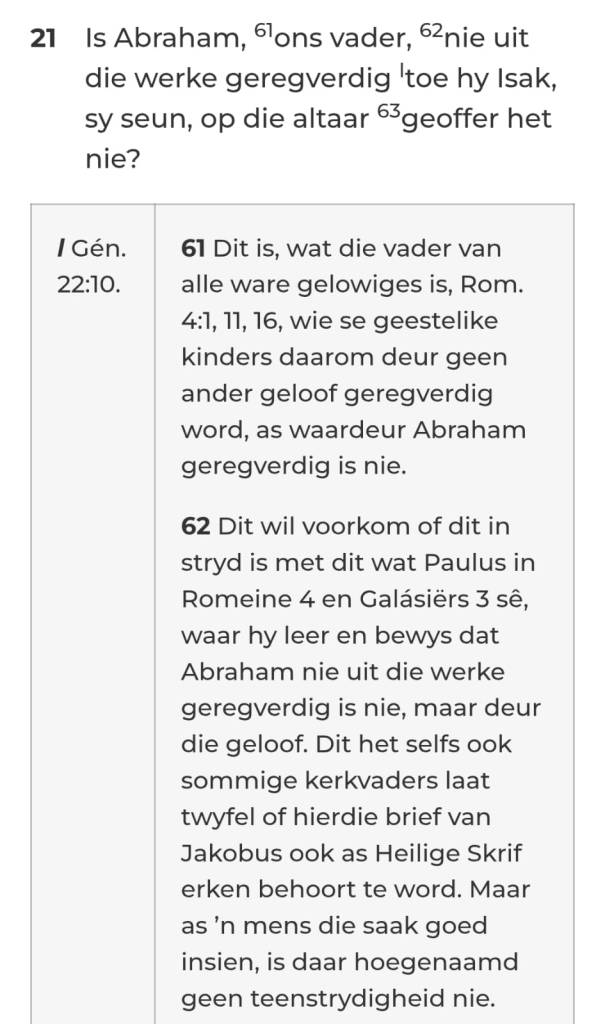
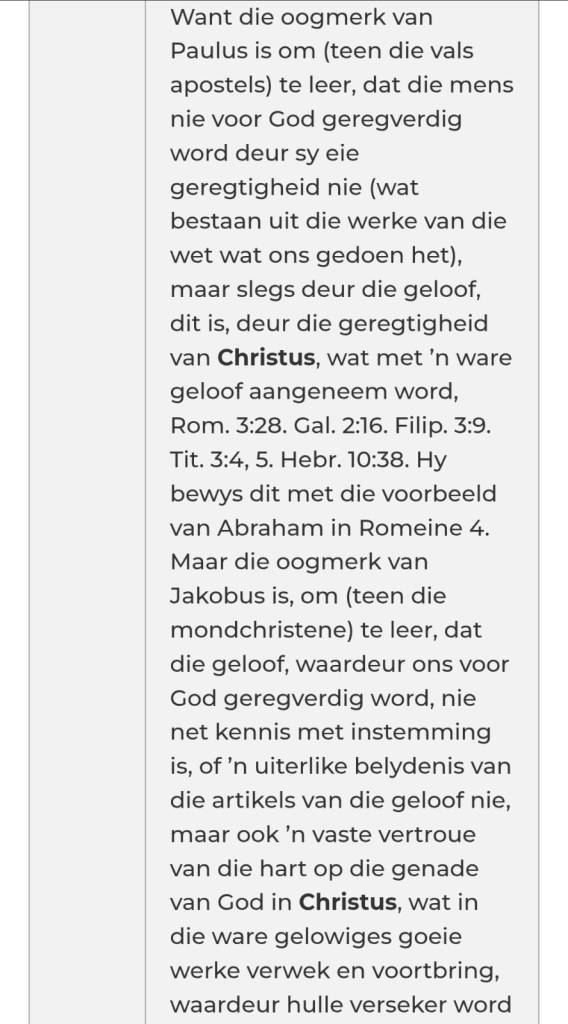
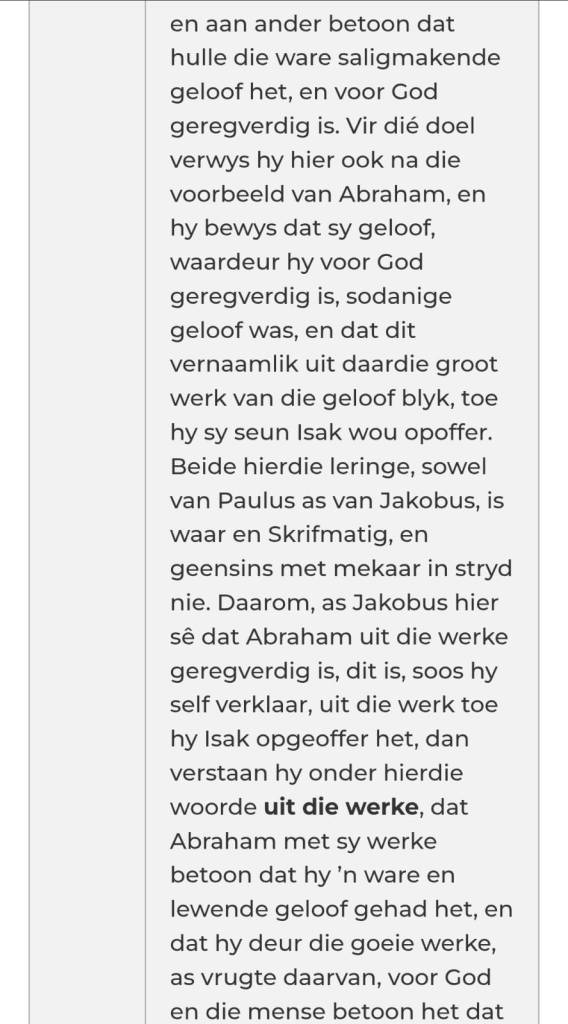
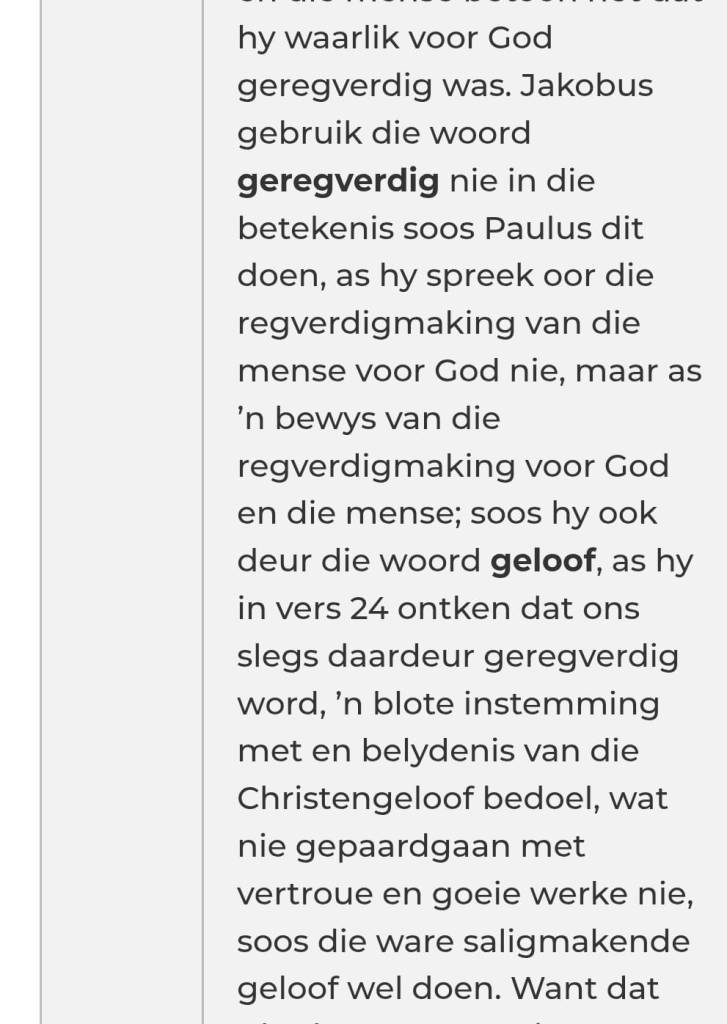
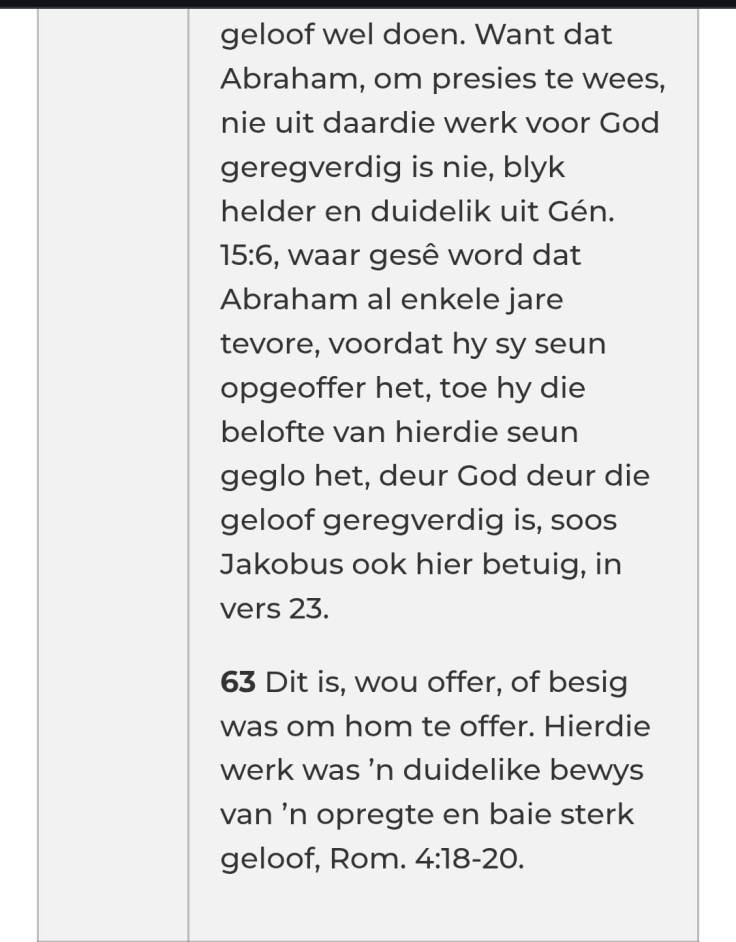
Nota: Gaan lees gerus die kanttekeninge by die volgende tekste waarop die bybels-gereformeerde regverdigingsleer, oftewel verlossingsleer (redding uit genade alleen, deur die geloof in Christus alleen) begrond is: Romeine 3:20-31; die hele hoofstuk 4 en 5; 8:29-39; 11:6; Filp. 3:8-10; 2 Tim. 1:8,9; Tit. 3:3-8, ens.
2) Die langer antwoorde:
1) MY TWEE PREKE OOR JAKOBUS 2:14-26
1.1) Tema: Geloof alleen red, maar die geloof wat red, is nie alleen nie
Luister hier: Jak. 2:14-18 deel 1
Preek by GK Bet-el: https://www.youtube.com/watch?v=tu7A8iqyDwI
“1. Die Skrif weerspreek hom nie, en daarom moet ons Skrif-met Skrif vergelyk. Dus, Paulus en Jakobus, albei geinspireer deur die Gees van God weerspreek mekaar nie, daarom moet ons biddend soek na die harmonie tussen hierdie 2 Skrifgedeeltes.
2. Ons moet let daarop hoe skrywers dieselfde woorde, hier spesifiek ‘geloof, werke en regverdiging’ verskillend gebruik.
3. Daar moet versigtig gelet word op watter spesifieke saak elke skrywer deur sy brief fokus, dus wat is die spesifieke saak wat Paulus of Jakobus aanspreek.
(Hierdie beginsels van Skrifverklaring is belangrik om enige Skrifgedeelte te bestudeer, en ons gaan daarna verwys in die verklaring en toepassing van die Skrif uit ons teksgedeelte).”
Ons gaan na drie sake kyk, vandag die eerste saak (deel 1), en volgende week die laaste twee sake (deel 2):
- watter soort geloof word veroordeel, v.14-18
- die verhouding tussen geloof en werke, v.18, 19
- die getuienis van die Skrif oor geloof en werke, v.20-26
1.2) Tema: Geloof sonder werke is dood, en is dan geen ware geloof nie
Luister hier: Jak. 2:19-26 deel 2
- die regte verhouding tussen geloof en werke, v.18,19
- die getuienis van die regte verhouding tussen geloof en werke vanuit die OT, v.20-26
‘n Aanhaling:
“Nou geliefdes, ons vat saam. Onthou, ons wil geloof en werke reg verstaan, omdat ons gered word nie net om reg te lewe nie, maar ook reg te glo, alles tot eer van God. Daarom moet ek heeltyd leer, bid en besin of ek die Skrif, my geloof reg verstaan, sodat ek nie die Here se eer aantas nie. Dit is veral Paulus se fokus. Maar so ook my lewe, Waarvan getuig my lewe, is dit sê en doen? Sien ek goeie vrugte in my lewe, groei ek daarin? Regverdig (bevestig en getuig) my dade die opregtigheid, waarheid van my belydenis van geloof ? En ja, een van die werke is dan juis, vlug na Christus, lewenslank! Ef.2:8-10!”
2) Sien hierdie onlangsle lesing wat breedvoerig die saak aanspreek en Jak. 2:14-26 verklaar:
Justification and Good Works? Luther and Calvin on the Book of James, by Rev. Dr. Dan Borvan
“Martin Luther and John Calvin held divergent views concerning the Epistle of James relative to the doctrine of justification, particularly in relation to the interplay between faith and works. Martin Luther, championing sola fide—justification by faith alone—approached James with caution, famously calling it an “epistle of straw” because he believed it lacked the evangelical clarity of Pauline texts like Romans and Galatians. For Luther, James 2 seemed to obscure the instrumental role of faith by appearing to attribute justification to works. Calvin, however, upheld the epistle’s canonical authority and offered a more harmonized interpretation, arguing that James does not contradict Paul but emphasizes that true, living faith necessarily produces works as its fruit. Rev. Borvan explores this historical theological tension as well as offers an exposition of James 2: to distinguish but not separate justification and sanctification.”
3) The Reformed Harmony of Paul and James
“James makes plain that he does not contradict but is in full agreement with Paul regarding justification’s being by faith alone. In the midst of his impassioned contention with the antinomian abusers of gracious justification, James quotes Genesis 15:6, the text that figures so decisively in Paul’s theology of justification by faith alone in Romans 4: “Abraham believed God, and it was imputed unto him for righteousness” (James 2:23; Rom. 4:3). Long before Isaac was born and therefore long before Abraham offered his son on the altar, which work, James says in verse 21, demonstrated his justification, Abraham was justified by faith—by faith alone. Faith was imputed to Abraham for righteousness, faith apart from any good work on Abraham’s part, specifically the awesome good work of offering his son on the altar.”
Slot
Sinclair Ferguson vat dit goed saam, in sy artikel, Sola Fide*:
“James’ teaching here in essence is that the man who is righteous by faith will be recognized and therefore counted as righteous through his deeds, just as Abraham was. The key, then, is verse 18: what a man does is the touchstone of faith. So, true faith, which alone justifies, is expressed by what a man does, not by what he presumes. The man who lives faithfully is the justified man (although he is not justified by living faithfully). Deedless faith cannot save, not because works are the ground of justification, but because the lack of works is an evidence of the absence of real faith.
James’ basic logic is that the faith alone by which we are justified is not an abstraction. It unites us to Christ as our righteousness and simultaneously as our sanctification. Expressed otherwise, James teaches that if he who professes faith is not also one whose faith expresses itself in practical works, then he does not believe with a faith that receives justification, and therefore does not believe truly. The one who genuinely believes is united to Christ, in the power of his new life, and such a one is also sanctified in Christ and works for his glory.
As John Murray puts it, ‘Faith alone justifies but a justified person with faith alone would be a monstrosity which never exists in the kingdom of grace.’ (Redemption Accomplished and Applied)
Or, as Calvin says, ‘We confess with Paul that no other faith justifies but faith working through love. But it does not take its power to justify from that working of love. Indeed it justifies in no other way but in that it leads us into fellowship with the righteousness of Christ.’ (Institutes, III.ii.20)
This is also what the Westminster Confession is at pains to emphasize: “Faith … is the alone instrument of justification: yet is it not alone in the person justified, but is ever accompanied with all other saving graces, and is no dead faith, but worketh by love.’ (WCF, XI. 2)
Thus wrote Luther in 1522: ‘O, when it comes to faith, what a living, creative, active, powerful thing it is. It cannot do other than good at all times… A man not active in this way is a man without faith. It is impossible, indeed, to separate works from faith, just as it is impossible to separate heat and light from fire.’ (Preface to Romans)
That is why faith alone, sola fide, is never lonely!”
*Some Pastors and Teachers: Reflecting a Biblical Vision of what every minister is called to be. Banner of Truth: 2017: p. 502-503. Beklemtonings bygevoeg.
______________________
Verdere bronne om te raadpleeg: e Reformasie en Rome
Calvyn se twee duidelike skrywes en weerleggings van die Roomse dwalinge:
ACTS OF THE COUNCIL OF TRENT WITH THE ANTIDOTE
JOHN CALVIN TO THE PIOUS READER.
“It is said that Cato, when about to address the Roman People for the purpose of urging them to correct their extravagant expenditure, began by premising that he should have a difficult task to perform, as the belly had no ears. My task, were I to exhort the Romanists of the present day to restore the doctrine of godliness, and cleanse the Church of corruption, would be much more difficult: for I should have to contend not only with a deaf belly, but with blind ambition. We seer that however they may be vanquished in argument, they nevertheless continue obstinate because they think they have to fight for honor and life. I will not, therefore, be so foolish as to attempt in vain to recall them to a sound mind; those of them, I mean, whose contumacy is seen to be altogether desperate. I will rather turn in a different direction, and let all the godly see how abominable the impiety of those men is. Of this I here exhibit no obscure specimen in The Acts of the Council of Trent, in which they have so explained all their inward feelings, as to leave, nobody in doubt what the state of the Church would be if it depended on their decision. But that this may the better appears I beg and exhort my readers first to peruse my treatise on the Necessity of Reforming the Church; and thereafter, on comparing, decide to which party they ought to incline.” GENEVA, 21st November 1547.
Sien hierdie lesing en artikel oor Calvyn se skrywe teen Rome:
Calvin – Trent and Justification
“Calvin’s response to Trent is so valuable that it should be read in its entirety. This brief summary should encourage us, however, to keep the doctrine of justification clear in our minds and central to our Christian life. Spiritual balance and power flow from this doctrine when it is rightly understood and rightly related to other elements of Christian truth.
In our day when the church is so weak and confused in many ways, we must not be led astray into thinking that either moralism or anti-nomianism will help us. Moralism destroys the glorious liberty we have through the work of Christ. It draws attention away from Christ and His grace. Antinomianism misses the call to holiness in Scripture and reinforces the serious erosion of morality in our society generally and in our churches.
The work of Christ and the holiness of God are at stake in understanding justification properly. Meditating on justification will draw us closer to Christ “who became to us wisdom from God, and righteousness and sanctification, and redemption” (1 Corinthians 1:30).”
“Calvin’s Commmentary on the Council of Trent”:
The Necessity of Reforming the Church
“Forget the Institutes; read this brief treatise of less than a hundred pages and you will know more about what is important to Calvin than you will by slogging through the Institutes (and then, when you finish, go slog through the Institutes). Calvin, in this letter/essay, argues that two things must be reformed if the church is not to die entirely, and two things in this order–how to worship God rightly, and how we are made right with God (justification). Personally, I wouldn’t want to live without the Institutes (though Edwards got along fine without them; they weren’t published in the colonies before or during Edwards’s lifetime), but as someone who lives among the conservative reformed communions, if I had to choose which I wish other people read, I would choose this over the Institutes.” – T David Gordon.
Philip Schaff on the “The Unanimous Consent of the Fathers” Illusion
“At least we cannot apply the scale of fully developed orthodoxy, whether Greek, Roman, or Evangelical, to the ante-Nicene fathers. Their dogmatic conceptions were often very indefinite and uncertain. In fact the Roman church excludes a Tertullian for his Montanism, an Origen for his Platonic and idealistic views, an Eusebiusfor his semi-Arianism, also Clement of Alexandria, Lactantius, Theodoret, and other distinguished divines, from the list of “fathers” (Patres), and designates them merely “ecclesiastical writers” (Scriptores Ecclastici).
In strictness, not a single one of the ante-Nicene fathers fairly agrees with the Roman standard of doctrine in all points. Even Irenaeus and Cyprian differed from the Roman bishop, the former in reference to Chiliasm and Montanism, the latter on the validity of heretical baptism. Jerome is a strong witness against the canonical value of the Apocrypha. Augustin, the greatest authority of Catholic theology among the fathers, is yet decidedly evangelical in his views on sin and grace, which were enthusiastically revived by Luther and Calvin, and virtually condemned by the Council of Trent. Pope Gregory the Great repudiated the title “ecumenical bishop” as an antichristian assumption, and yet it is comparatively harmless as compared with the official titles of his successors, who claim to be the Vicars of Christ, the viceregents of God Almighty on earth, and the infallible organs of the Holy Ghost in all matters of faith and discipline. None of the ancient fathers and doctors knew anything of the modern Roman dogmas of the immaculate conception (1854) and papal infallibility (1870).
The “unanimous consent of the fathers” is a mere illusion, except on the most fundamental articles of general Christianity. We must resort here to a liberal conception of orthodoxy, and duly consider the necessary stages of progress in the development of Christian doctrine in the church. A General Estimate of the Fathers On the other hand the theology of the fathers still less accords with the Protestant standard of orthodoxy.
We seek in vain among them for the evangelical doctrines of the exclusive authority of the Scriptures, justification by faith alone, the universal priesthood of the laity; and we find instead as early as the second century a high estimate of ecclesiastical traditions, meritorious and even over-meritorious works, and strong sacerdotal, sacramentarian, ritualistic, and ascetic tendencies, which gradually matured in the Greek and Roman types of catholicity.
The Church of England always had more sympathy with the fathers than the Lutheran and Calvinistic Churches, and professes to be in full harmony with the creed, the episcopal polity, and liturgical worship of antiquity before the separation of the east and the west; but the difference is only one of degree; the Thirty-Nine Articles are as thoroughly evangelical as the Augsburg Confession or the Westminster standards; and even the modern Anglo-Catholic school, the most churchly and churchy of all, ignores many tenets and usages which were considered of vital importance in the first centuries, and holds others which were unknown before the sixteenth century.
The reformers were as great and good men as the fathers, but both must bow before the apostles. There is a steady progress of Christianity, an ever-deepening understanding and an ever-widening application of its principles and powers, and there are yet many hidden treasures in the Bible which will be brought to light in future ages.
In general the excellences of the church fathers are very various. Polycarp is distinguished, not for genius or learning, but for patriarchal simplicity and dignity; Clement of Rome, for the gift of administration; Ignatius, for impetuous devotion to episcopacy, church unity, and Christian martyrdom; Justin, for apologetic zeal and extensive reading; Irenaeus, for sound doctrine and moderation; Clement of Alexandria, for stimulating fertility of thought; Origen, for brilliant learning and bold speculation; Tertullian, for freshness and vigor of intellect, and sturdiness of character; Cyprian, for energetic churchliness; Eusebius, for literary industry in compilation; Lactantius, for elegance of style. Each had also his weakness.
Not one compares for a moment in depth and spiritual fulness with a St. Paul or St. John; and the whole patristic literature, with all its incalculable value, must ever remain very far below the New Testament. The single epistle to the Romans or the Gospel of John is worth more than all commentaries, doctrinal, polemic, and ascetic treatises of the Greek and Latin fathers, schoolmen, and reformers. … The Roman church extends the line of the Patres, among whom she further distinguishes a small number of Doctores ecclesiae emphatically so-called, down late into the middle ages, and reckons in it Anselm, Bernard of Clairvaux, Thomas Aquinas, Bonaventura, and the divines of the Council of Trent, resting on her claim to exclusive catholicity, which is recognized neither by the Greek nor the Evangelical church.”
Source: History of the Christian Church, vol 2: Ante-Nicene Christianity, AD 100-325, #160
Sien ook hierdie video oor die kerkvaders: Why the Church Fathers Don’t Scare Protestants


Leave a Reply