CALVIN’S IMPORTANT SERMONS ON DEUTERONOMY 22:5
by Prof. Cory Griess*
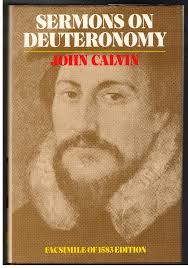
“The woman shall not wear that which pertaineth unto a man, neither shall a man put on a woman’s garment: for all that do so are abomination unto the Lord thy God.” – Deut. 22:5
“I charge thee therefore before God, and the Lord Jesus Christ, who shall judge the quick and the dead at his appearing and his kingdom; 2 Preach the word; be instant in season, out of season; reprove, rebuke, exhort with all long suffering and doctrine.” – 2 Tim. 4:1,2
Some quotes from this very important articleS by prof. Griess, that needs to be studied prayerfully and carefully for our times, knowing it won’t sound ‘nice’ for some ears, not only outside, but also within the visible churches of our times (see 2 Tim. 4:1-5, with the very important comfort of verse 6-8 to keep on preaching, by the grace of God, in a spirit of meekness and boldness, what all true believers, and even more so pastors must follow in “2 Tim. 3:1-9 times”, namely: 2 Tim. 3:10-4:5, for the love of His church, and the glory of His Name, see 2 Tim. 2:9,10, bold added):
“Calvin’s sermon is helpful for the church facing the issue of transgender behavior and activism today in four ways: First, in Calvin’s belief that Deuteronomy 22:5 applies to the New Testament church; second, in Calvin’s pointing the church to the seventh commandment when he preaches the text; third, in Calvin’s pointing the church to the ninth commandment when he preaches the text; fourth, in Calvin’s pious unwillingness to allow compromise of the text’s prohibition. For each of the four points I will explain Calvin’s understanding and then demonstrate how his understanding is helpful for the church in today’s context. …
In Calvin’s first sermon on Deuteronomy, he explained that the Old Testament law still applies in the New Testament. The law “not only served till the coming of the Son of God: but also serves still to our behalf, and shall do so still to the world’s end.” The question is how does the Old Testament law remain applicable to us to the world’s end? Calvin divided the Old Testament laws into the three traditional categories: civil, ceremonial, and moral. The moral law endures for all times and places. The principles in the civil and ceremonial laws endure, while the laws themselves fall away at the coming of Christ. How does Deuteronomy 22:5 fit into these categories? Calvin believed Deuteronomy 22:5 was a civil law that is at the same time entirely moral. In other words, it was an application of the moral law to Israel, but in such a way that it applied in all times and places. …
While wisdom would say that Christians ought not directly confront a person immediately about their pronoun usage, that is very different from the advice that a Christian may deliberately lie by calling someone a “he,” when it is known that the person is a “she” (or vice versa). This makes one culpable for cementing the lie the person has been telling himself or herself. As much as one’s heart breaks for the pain and confusion of the person, love for God and neighbor ought to constrain the Christian not to heed the advice Yarhouse, Sprinkle, and Walker give. The Christian may not break the ninth commandment! … Calvin saw a slippery slope in small compromises of Deuteronomy 22:5. …
Calvin’s simple yet fervent piety comes through: “Although no evil ensued thereof, yet the very thing itself displeases God. We hear what is said of it in this place: Whosoever does it, is an abomination. Ought not this saying to make the hair of our heads stand up, rather than we would provoke God’s wrath upon us willfully. …
Calvin could not and would not have predicted the state of the world in the twenty-first century. And yet, “there is no new thing under the sun” (Eccl. 1:9). Even gender dysphoria and transgender behavior were part of Calvin’s world. Indeed, they were part of the world when God inspired the Bible. Calvin’s sermon on Deuteronomy 22:5 offers a wealth of help for God’s people as they think through today’s challenges. In Calvin’s understanding of the law of God, his pointing the church to both the seventh and ninth commandments, and his unwillingness to allow any compromise with sin, Calvin can be of great help to the church as she faces the challenge of transgender behavior and activism, both within and without her walls.” – prof. Griess
[*professor of Practical Theology in the Protestant Reformed Theological Seminary, and member of First PRC in Grand Rapids, Michigan. With acknowledgment, these two articles are posted here in full as it was published in the Standard Bearer, a monthly reformed magazine of the PRCA.]
Article 1: CALVIN’S IMPORTANT SERMON ON DEUTERONOMY 22:5 (January 2026, Vol. 102, nr. 5) – see below
Article 2: CALVIN ON CLOTHING (March 2026, vol. 102, nr. 7) can be read here: Clothing – Deut. 22:5
_____________________
Article 1: CALVIN’S IMPORTANT SERMON ON DEUTERONOMY 22:5 (January 2026, Vol. 102, nr. 5)
“The woman shall not wear that which pertaineth unto a man, neither shall a man put on a woman’s garment: for all that do so are abomination unto the Lord thy God” — Deuteronomy 22:5
INTRODUCTION
The church of Christ, especially in Western nations, exists in societies undergoing a moral revolution. The center of that revolution right now concerns whether or not biological sex and gender are one. Historically it has been so, but transgender activism separates the two, teaching that the source of one’s gender ought not necessarily be one’s biological sex. Inward feelings of dysphoria concerning one’s sex may and ought to dominate a person’s identity to the point that those feelings determine dress, behavior, and (since the advent of endocrinology and reconstructive surgery in the 1950s) bodily sexual characteristics. One must overcome sex, not endeavor to bring one’s inner sense of self in line with one’s sex.
The teaching of Scripture, however, is the opposite.
Even though both gender and sex are affected by the fall, gender and sex are indivisible. God calls the church to the task of upholding this basic truth in the face of mounting pressure, all the while ministering to those who fight against its irrepressible reality. To do so is to invite criticism, even hatred, which the faithful church in the West at times experiences. It strikes me that few if any, even in Reformed churches, are looking back into the Reformed tradition for help in facing the issue of transgender behavior. This article begins to remedy that oversight by examining John Calvin’s sermon on Deuteronomy 22:5.
Deuteronomy 22:5 is the Old Testament prohibition against cross-dressing. Calvin preached on this text late in his life in a series of over 200 sermons on Deuteronomy, preached between March 1555 and July 1556. His sermon is important for the contemporary church to consider.
DOES THE TEXT OF SCRIPTURE SPEAK TO THE CURRENT SITUATION?
Before engaging Calvin on Deuteronomy 22:5, however, we must face two questions: First, does the Bible text of Calvin’s sermon apply to the current issues the church faces? And, second, could John Calvin, preaching on this Bible text, possibly apply the text to issues that are the same as those the church faces today?
Concerning the first question, transgender activists within the church world argue that the text does not speak to transgender issues. They argue the text only applies to those who cross-dress for sexual purposes. But notice, the text is sweeping in its prohibition. The command of the text clearly forbids any social expression different from one’s sex, regardless of the reason. Whether or not the behavior is for sexual arousal, or because one thinks he or she is actually a different gender, the prohibition applies. It is an allencompassing, divine “No!”
What about the second question: does John Calvin have any understanding of the issues as we face them today? For one thing, cross-dressing did exist in Geneva during Calvin’s ministry. Speaking of men, Calvin says, “We see diverse times that they attire themselves like brides.” And, speaking of the offense in women, he says, “Again, when women go appareled like men of war…it is against kind, and we ought to abhor it.”(1)
More importantly, Calvin was aware on some level of people who were (as we would say today) gender dysphoric—that is, uncomfortable with their own sex and gender. In the sermon on Deuteronomy 22:5 Calvin says he is aware of men who at times “seem to be sorry that God made them not women.”(2)
What could he be referring to, other than people who on some level experience what we now call gender dysphoria? Both the text itself and Calvin’s recognition of the issue make Calvin’s sermon on the text applicable to the current situation.
CALVIN’S SERMON IS HELPFUL IN FOUR WAYS
Calvin’s sermon is helpful for the church facing the issue of transgender behavior and activism today in four ways: First, in Calvin’s belief that Deuteronomy 22:5 applies to the New Testament church; second, in Calvin’s pointing the church to the seventh commandment when he preaches the text; third, in Calvin’s pointing the church to the ninth commandment when he preaches the text; fourth, in Calvin’s pious unwillingness to allow compromise of the text’s prohibition. For each of the four points I will explain Calvin’s understanding and then demonstrate how his understanding is helpful for the church in today’s context.
#1—CALVIN BELIEVED DEUTERONOMY 22:5 IS BINDING LAW FOR THE NEW TESTAMENT
Calvin’s Understanding In Calvin’s first sermon on Deuteronomy, he explained that the Old Testament law still applies in the New Testament. The law “not only served till the coming of the Son of God: but also serves still to our behalf, and shall do so still to the world’s end.”(3) The question is how does the Old Testament law remain applicable to us to the world’s end? Calvin divided the Old Testament laws into the three traditional categories: civil, ceremonial, and moral.(4) The moral law endures for all times and places. The principles in the civil and ceremonial laws endure, while the laws themselves fall away at the coming of Christ.
How does Deuteronomy 22:5 fit into these categories? Calvin believed Deuteronomy 22:5 was a civil law that is at the same time entirely moral. In other words, it was an application of the moral law to Israel, but in such a way that it applied in all times and places. Therefore, Calvin preached the prohibition to his congregation as a moral law, stating explicitly, “It is but only an exposition of this saying of his [God’s], ‘Thou shalt not commit adultery.’”(5) Because it is part of the moral law, the church must read Deuteronomy 22:5 and conclude that even though it is in the Old Testament, it is in force still today.(6)
Help for Today
The argument of some transgender activists in the sphere of apostatizing churches is that the only divine command that is in force in the New Testament is an ill-defined command to love God and love one’s neighbor. Their contention is that the command in Deuteronomy 22:5, and indeed every Old Testament law, fell away with the coming of Christ. Therefore, as one representative concludes, “laws related to sexual conduct” do not “carry over into the New Testament.”(7) All laws regulating sexual ethics fell away with the coming of Christ, including Deuteronomy 22:5. Calvin’s understanding of the applicability of Old Testament law, and of the prohibition in Deuteronomy 22:5 in particular, are vitally important for the church to maintain against the compromises of the apostatizing church today.
# 2—TRANSGENDER BEHAVIOR IS A SEVENTH COMMANDMENT ISSUE
Calvin’s Understanding In his sermon on Deuteronomy 22:5, Calvin points out the prohibition in the text is specifically a seventh commandment issue:
Therefore, whereas in this text it is said that the man shall not wear the apparel of the woman; does God let down an eleventh commandment? Did God bethink himself better afterward and add somewhat else to that which we had heard of him heretofore? No, it is but only an exposition of this saying of his, Thou shalt not commit adultery.(8)
Calvin recognized that cross-dressing was often a sexual perversion. And while in itself it is not the act of adultery, for Calvin, it was a “vice that tendeth towards adultery.”(9)
Help for Today
What about transgender people who cross-dress because they claim to be another gender? Are there seventh commandment issues here? Normally, these people take offense at the notion that there are any sexual desires involved and that the seventh commandment applies to their situation. The two concepts of gender identity and sexuality are distinct according to transgender activism. One refers to what gender one feels one is, the other to the gender one finds attractive. How should the church respond? The church ought not quickly agree with the notion that a person’s transgender claims are always free of sexual overtones. Is it not the case that the more diverse and perverse the sexual attractions are, the less definable the subjective identity is? The two are not partitioned off from one another. Listen to the testimony of one anonymous faithful pastor who experienced gender dysphoria for years, but whom God delivered:
After that period, the longing to be a woman came back. I never again got close to my previous obsession level as a youth, but I struggled quite often with daydreaming about being a woman. Cross-dressing also became something that usually was sexually pleasurable. Because of this it became especially addictive. (Many years later I learned that this sexual pleasure from cross-dressing is a common temporary stage or even a permanent characteristic for the majority of male-to-female biological men who identify as transgender. Trans activists aren’t quick to reveal this fact because many transsexuals feel shameful about it as it feels like an invalidation of their transsexuality. This fact also makes transsexualism less palatable to the public. From what I’ve read from various studies, I approximate that about 75% of m-t-f transsexuals experience this).”(10)
In other words, this pastor argues, in 75% of male to female cases, errant sexual desires are wrapped up with gender identity. If this is correct, Calvin was correct.
# 3—TRANSGENDER BEHAVIOR IS A NINTH COMMANDMENT ISSUE
Calvin’s Understanding The ninth commandment says, “Thou shalt not bear false witness.” Importantly, Calvin saw the breaking of God’s law in Deuteronomy 22:5 as a ninth commandment issue just as much as a seventh commandment issue. Calvin says to dress opposite one’s sex is to be dishonest. It is to disguise reality.
For they that love to go so disguised, do despise God: as for example…when men put themselves into women’s apparel, and women put themselves into men’s….
Seven times in the sermon, Calvin calls for “honesty” in the dressing of oneself. He says,
Whereupon we have to remember that God likes well that there should be an honesty even in our apparel.… Then is it as a witness that we walk as before God when we regard a kind of honesty in our apparel.(11)
Calvin’s point is, someone who presents himself/herself in dress (or otherwise) as a different gender from his/her sex, lies. “Disguising” oneself by one’s clothing is lying, and “honesty” in clothing is telling the truth. Even if God has not specifically prescribed what kinds of clothes are men’s or women’s, God has prescribed that clothing be distinct for the two genders. This is something that the prohibition in Deuteronomy 22:5 itself calls for. A prohibition against cross-dressing assumes gender specific dress. Calvin taught that honesty requires dressing according to one’s God-assigned gender, while dressing according to the opposite gender is breaking the ninth commandment—bearing false witness.
Help for Today
The church must contend for what Calvin observes here. Presenting oneself as a gender that is different from one’s sex, whether that is the opposite gender, or some other supposed gender, or even in an attempt to present oneself as gender-less, is sin against the ninth commandment. The church has not spoken of this enough. The ninth commandment forbids gender expressions that lie to the world about one’s sex in any way. It also forbids lying about one’s sex by the use of certain pronouns. Calvin’s emphasis on the ninth commandment can help the church with the pressing question of whether or not to use a transgender person’s “preferred pronouns.” Christians increasingly face this moral dilemma. Have you faced this yet? Many have. Adding to the pressure, laws are being passed requiring the use of a person’s preferred pronouns.(12) What does the Christian do?
Mark Yarhouse, one of the leading evangelical authors on this issue, advises, “It is an act of respect, even if we disagree, to let the person determine what they want to be called.”(13) Preston Sprinkle, another popular evangelical writer, likewise advises using a transgender person’s preferred pronouns as a sign of “hospitality” and “meeting people where they are.”(14) Andrew T. Walker in his otherwise excellent book agrees: “My own position is that if a transgender person comes to your church, it is fine to refer to them by their preferred pronoun.”(15) While wisdom would say that Christians ought not directly confront a person immediately about their pronoun usage, that is very different from the advice that a Christian may deliberately lie by calling someone a “he,” when it is known that the person is a “she” (or vice versa). This makes one culpable for cementing the lie the person has been telling himself or herself. As much as one’s heart breaks for the pain and confusion of the person, love for God and neighbor ought to constrain the Christian not to heed the advice Yarhouse, Sprinkle, and Walker give. The Christian may not break the ninth commandment!
Walker’s additional advice is better, “The best solution is to avoid pronouns altogether if possible.”(16) Nonetheless, likely the day comes when Christian conviction regarding the ninth commandment will mean loss of job or freedoms. If so, God calls believers to suffer for righteousness’ sake. Calvin helps us think rightly about these matters by focusing as much attention on the ninth commandment as on the seventh. In the process, he helps us steel ourselves for what may come.
# 4—NO COMPROMISE
Calvin’s Understanding Calvin faced the objection from his own community that wearing the clothing of the opposite sex ought not be of great concern: “Truly it should seem to be no matter of great importance for a man to be appareled after one fashion or other.”(17) But in the sermon on Deuteronomy 22:5 Calvin called the church to “eschew all looseness,”(18) even if it seemed to others like small compromises would do little damage to oneself and/or to others. Calvin saw a slippery slope in small compromises of Deuteronomy 22:5. He warned, “Propriety and modesty are prescribed, not only for decency’s sake, but lest one kind of liberty should at length lead to something worse.”(19) In another place he added,
When men put themselves into women’s apparel, and women put themselves into men’s as ye know: what comes of it?…We are sure that the suffering thereof is the opening of a gap to all whoredom. At a word, such disguisings are but enticements to bawdry, as experience proveth.(20)
Calvin has an honest understanding of human nature. When we let ourselves go an inch, our nature takes a mile. Sin is never content with a little bit, but having gained a foothold, it will push for more. And having become weak by giving in to the little thing, we are prone to give in to the greater thing. Calvin brooked no small compromises of the prohibition in Deuteronomy 22:5 also because he expected the Christian to love and reverence God enough to keep His commandments.
Commenting on the final part of the verse that says cross-dressing is an “abomination” before God, Calvin’s simple yet fervent piety comes through: “Although no evil ensued thereof, yet the very thing itself displeases God. We hear what is said of it in this place: Whosoever does it, is an abomination. Ought not this saying to make the hair of our heads stand up, rather than we would provoke God’s wrath upon us willfully.”(21)
Help for Today
Mark Yarhouse recommends that the church allow Christians who experience gender dysphoria to ease the discomfort by taking on certain limited transgender expressions both in dress and behavior: “Some may live a gender identity that reflects their biological sex, depending on their discomfort. Others may benefit from …find[ing] ways to identify with aspects of the opposite sex, as a way to manage extreme discomfort.”(22)
While one sympathizes with the distressing experience of gender dysphoria, this is wicked advice. Compromising with the distressing feelings will bring a short-term comfort, but it will only bring a greater long-term discomfort. Is not Yarhouse’s approach similar to advising a Christian addicted to pornography to look at suggestive pictures when the temptation becomes extremely uncomfortable, in an effort to temporarily ease the temptation?
For the child of God who struggles with gender dysphoria or any of the sinful desires that arise within him, Calvin’s instruction provides better help. It is indeed true that a Christian’s hair ought to stand on end when he hears God call this an abomination. Is it not enough for us at the end of the day to recognize that it displeases Him, the God who loves His people and exonerates them in Christ from their sins?
CONCLUSION
Calvin could not and would not have predicted the state of the world in the twenty-first century. And yet, “there is no new thing under the sun” (Eccl. 1:9). Even gender dysphoria and transgender behavior were part of Calvin’s world. Indeed, they were part of the world when God inspired the Bible. Calvin’s sermon on Deuteronomy 22:5 offers a wealth of help for God’s people as they think through today’s challenges.
In Calvin’s understanding of the law of God, his pointing the church to both the seventh and ninth commandments, and his unwillingness to allow any compromise with sin, Calvin can be of great help to the church as she faces the challenge of transgender behavior and activism, both within and without her walls.
_____________________________________________
1 Both quotations from Calvin, Sermons on Deuteronomy.
2 Calvin, 773.
3 Calvin, 4.
4 The distinction between civil, ceremonial, and moral law is consistent throughout church history. Augustine appealed to it. Aquinas did the same. Melanchthon, Calvin, and the Reformation tradition carried it forward as is evident from Belgic Confession, Article 25 and The Westminster Confession of Faith, Chapter 19.
5 Calvin, Sermons on Deuteronomy, 774.
6 Calvin also saw the prohibition as part of the law revealed in nature. “That is the effect of God’s intent in saying that men ought not to put on women’s apparel, nor women ought not to be clothed in men’s apparel: For it is good reason that there should be a difference between men and women. And although there were no law written, does not even nature teach it us?” (Sermons on Deuteronomy, 773). Calvin believed all ten of the Ten Commandments were revealed in nature.
7 The Reformation Project, “The Prohibitions in Leviticus Do Not Apply to Christians,” Accessed 12/10/25, https://reformationproject.org/case/levitical-prohibitions/
8 Calvin, 774.
9 Calvin, 774.
10 “Freedom from Gender Confusion: A Pastor’s Testimony,” The Abide Project. Accessed 2/22/24. https://www.abideproject. org/p/freedom-from-gender-confusion.
11 Calvin, Sermons on Deuteronomy, 773.
12 For example, in New York City one can be fined up to 250,000 USD for intentionally not using someone’s preferred pronouns: Eugene Volokh, “You can be fined for not calling people ‘ze’ or ‘hir,’ if that’s the pronoun they demand that you use,” Washington Post, May 17, 2016.
13 Mark Yarhouse, “Understanding the Transgender Phenomenon,” Christianity Today, June 8, 2015. Accessed 12/22/22. https://www.christianitytoday.com/ct/2015/julyaugust/understanding-transgender-gender-dysphoria.html.
14 Preston Sprinkle, Embodied: Transgender Identities, the Church, and What the Bible Has to Say (Colorado Springs, CO: David C. Cook, 2021), 208-209.
15 Andrew T. Walker, God and the Transgender Debate (UK: Good Book Company, 2017), 157.
16 Walker, God and the Transgender Debate, 157.
17 Calvin, Sermons on Deuteronomy, 773.
18 Calvin, 773.
19 Calvin, Commentaries on the Four Last Books of Moses: Arranged in the Form of a Harmony, 3, 110.
20 Calvin, Sermons on Deuteronomy, 773.
21 Calvin, 773.
22 Yarhouse, “Understanding the Transgender Phenomenon.”
_____________________________________________________________
Article 2: CALVIN ON CLOTHING (March 2026, vol. 102, nr. 7) – next time
_____________________________________________________________
Nog artikels van of oor Calvyn hier op Pro Regno
Sien ook:
Wissel van geslachtskleding en van geslacht: Deut. 22:5 en genderdysforie, dr, HJ Koorevaar
Resensie: Dr. P. de Vries
Man and Woman in Christ: n Examination of the Roles of Men and Women in Light of Scripture and the Social Sciences, SB Clark
The Covenant Enforced: Sermons on Deuteronomy 27 and 28
BOEKE TE KOOP BY: https://proregno.com/category/pro-regno-boeke-te-koop/

 PRO REGNO
Leave a comment