CHRISTIAN CIVILIZATION AND THE TRANSFORMATION OF SOCIETY
CONTRA TWO KINGDOMS THEOLOGY
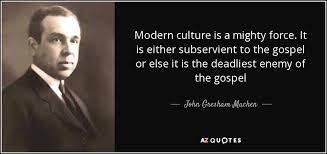
“Thus Christianity differs from liberalism in the way in which the transformation of society is conceived. But according to Christian belief, as well as according to liberalism, there is really to be a transformation of society; it is not true that the Christian evangelist is interested in the salvation of individuals without being interested in the salvation of the race. And even before the salvation of all society has been achieved, there is already a society of those who have been saved. That society is the Church. The Church is the highest Christian answer to the social needs of man.” – J. Gresham Machen
“Machen believed in cultural engagement — not abandonment or rejection of culture — and in the transforming power of God’s grace to redeem society as well as individuals. Consecration, as Machen would say, is key.” Machen on the consecration of culture
Inleiding
Die ‘two kingdoms’ beweging het ‘n probleem met die verchristeliking van die ganse lewe, as vrug en gevolg van die Evangelie wat mense red en hul harte verander, soos RJ Rushdoony dit duidelik stel dat ‘Christendom’ of ‘Christelike beskawing’ of ‘christianisering’ moet die vrug en gevolg wees van redding, wedergeboorte wat alleen deur die Evangelie kom:
“The key to remedying the [modern] situation is not revolution, nor any kind of resistance that works to subvert law and order. The New Testament abounds in warnings against disobedience and in summons to peace. The key is regeneration, propagation of the gospel, and the conversion of men and nations to God’s law-word. Clearly, there is no hope for man except in regeneration.” (Institutes of Biblical Law, volume one, 1973, p. 113)
Sien hierdie video van ‘n ‘Two Kingdoms’ voorstaander, waar hy vra dat die term “Christian’ nie gebruik sal word vir bv. ‘Christelike nasionalisme’ nie, juis omdat die ‘Two Kingdoms’ beweging nie net ‘n probleem het (en elke gelowige saam hulle!) met die misbruike en verdraaiings van Christendom of Christelik beskawingsidees, ens. nie, maar hulle het ‘n wesentlike probleem met die ‘Christelike beskawing’ opsigself, as roeping en taak, wat die vrug is van die Evangelie (sien die volledige gesprek, teen o.a. die gedagte van ‘Christendom’, hier. Sien my eie lesing oor die onderwerp, Teonomiese vs Two Kingdoms koninkrykbeskouings hier).
Die wese van die Two Kingdoms se ‘anti-Christendom’ standpunt is nie net dat hul (en ons saam hulle!) misbruike en verdraaiings van o.a. NGB artikel 36 en WCF chapter XXIII standpunte en praktyke wil verander en verder ten goede reformeer nie, maar dat hul die onderliggende bybelse Koninkryksbeskouing en roeping van die gereformeerde belydenis en vaders verwerp waar dit bely word in navolging van die Skrif in die volgende woorde:
…. en die koninkryk van Jesus Christus te bevorder, die Woord van die evangelie orals te laat verkondig, sodat God deur elkeen geëer en gedien word soos Hy in sy Woord beveel.
Dit gaan in wese oor die Kroonregte, die Koningskap van Jesus Christus oor die ganse skepping (Ps. 2, 110; Filp. 2:9-11; Kol. 1:15-20; 1 Tim. 6:15, ens.), en die Kerk se roeping en taak om deur die prediking, maar ook alle gelowiges, in die amp van gelowige, die Koninkryk van God orals verkondig: Jesus is my Verlosser, maar ook my Here, my Koning van my ganse lewe (1 Kor. 10:31; Kol. 3;16-25, ens.)
Two Kingdoms se probleem is dus nie uitsluitlik met ‘teonomiste’ in die VSA nie, maar met die hele outentieke gereformeerde christendom sedert die Reformasie, wat wel oor die detail en spesifieke toepassings van die Christendom, die rol van wet en evangelie daarin verskil het (bv. veranderinge aan NGB art. 36 se bewoording), maar nie die wesentlike roeping en taak daarvan versaak het nie, soos blyk die Two Kingdoms nou propageer.
Hier is so paar aanhalings van een van die 20ste eeuse teoloë wat die Two Kingdoms voorstanders bewonder, wat lyk my ook ten gunste van ‘transformasie’ (Koningskap van Christus, kerstening, christianisering, ens. ‘reg’ verstaan) was van die ganse lewe as vrug en gevolg van die Evangelie van Christus alleen (om dus in dankbaarheid vir jou verlossing, Christus met jou hele siel, hart en verstand lief te hê in alles en op elke lewensterrein, Rom. 11:36-12:2; 1 Kor. 10:31; Kol. 3:16-25, ens.), asook daarna nog ‘n paar ander “christianisering” uitsprake van andere gereformeerde denkers soos Bavinck, Totius, Stoker, Floor, JH Bavinck, RJ Rushdoony (beklemtonings orals bygevoeg):
“Our Lord said: “Seek ye first the Kingdom of God and His righteousness, and all these things shall be added unto you. But if you seek first the Kingdom of God and His righteousness in order that all those other things may be added unto you, you will miss both those other things and the Kingdom of God as well (p. 152).”
Source: J. Gresham Machen and the Transformation of Culture
In What is Faith? J. Gresham Machen urged that “a new and more powerful proclamation of that law is perhaps the most pressing need of the hour…. A low view of laws always brings legalism in religion; a high view of law makes a man a seeker after grace. Pray God that the high view may again prevail” (pp. 141-142).
“The Christian cannot be satisfied so long as any human activity is either opposed to Christianity or out of all connection with Christianity. Christianity must pervade not merely all nations, but also all of human thought. The Christian, therefore, cannot be indifferent to any branch of earnest human endeavor. It must all be brought into some relation to the gospel. It must be studied either in order to be demonstrated as false, or else in order to be made useful in advancing the Kingdom of God. The Kingdom must be advanced not merely extensively, but also intensively.
The Church must seek to conquer not merely every man for Christ, but also the whole of man. We are accustomed to encourage ourselves in our discouragements by the thought of the time when every knee shall bow and every tongue confess that Jesus is Lord. No less inspiring is the other aspect of that same great consummation. That will also be a time when doubts have disappeared, when every contradiction has been removed, when all of science converges to one great conviction, when all of art is devoted to one great end, when all of human thinking is permeated by the refining, ennobling influence of Jesus, when every thought has been brought into subjection to the obedience of Christ.
But by whom is this task of transforming the unwieldy, resisting mass of human thought until it becomes subservient to the gospel–by whom is this task to be accomplished? To some extent, no doubt, by professors in theological seminaries and universities. But the ordinary minister of the gospel cannot shirk his responsibility.” (J. Gresham Machen)
Source: “Christianity and Culture” in The Princeton Theological Review, Vol. 11, 1913.
“Surely the only truly patriotic thing to teach the child is that there is one majestic moral law to which our own country and all the countries of the world are subject…. There will have to be recourse again, despite the props afforded by the materialistic paternalism of the modern State, to the stern, solid masonry of the law of God. An authority which is man-made can never secure the reverence of man; society can endure only if it is founded upon the rock of God’s commands.”
Source: “The Importance of Christian Scholarship” (1932), Education, pp. 41-42.
Instead of obliterating the distinction between the Kingdom and the world, or on the other hand withdrawing from the world into a sort of modernized intellectual monasticism, let us go forth joyfully, enthusiastically to make the world subject to God….
Source: “Reforming the Government Schools” (1925), ibid., pp. 62, 63.
“The Christian school is important for the maintenance of American liberty.”
Source: “The Necessity of the Christian School” (1934), ibid., p. 77.
“What do we find in this present-day America, in which the achievements of centuries are so rapidly being lost and in which that liberty which our fathers won at such cost is being thrown away recklessly by one mad generation? I think the really significant thing that we find is that America has turned away from God. In the political and social discussions ofthe day, God’s law has ceased to be regarded as a factor that deserves to be reckoned with at all…. A nation that tramples thus upon the law of God, that tramples upon the basic principles of integrity, is headed for destruction unless it repents in time. . . . The real reason why young men fall into crime is that the law of God is so generally disobeyed. . . . The real evil is the ruthless disregard of the law of God [by both individuals and states]”
Source: “The Christian School the Hope of America” (1934), ibid., 139-141
“But the state, even when reduced to its proper limits, has a large place in human life, and in the possession of that place it is supported by Christianity. The support, moreover, is independent of the Christian or non-Christian character of the state; it was in the Roman Empire under Nero that Paul said, “The powers that be are ordained of God.” Christianity assumes no negative attitude, therefore, toward the state, but recognizes, under existing conditions, the necessity of government. The case is similar with respect tto those broad aspects of human life which are associated with industrialism.
The “other worldliness” of Christianity involves no withdrawal from the battle of this world; our Lord Himself, with His stupendous mission, lived in the midst of life’s throng and press. Plainly, then, the Christian man may not simplify his problem by withdrawing from the business of the world, but must learn to apply the principles of Jesus even to the complex problems of modern industrial life. At this point Christian teaching is in full accord with the modern liberal Church; the evangelical Christian is not true to his profession if he leaves his Christianity behind him on Monday morning. On the contrary, the whole of life, including business and all of social relations, must be made obedient to the law of love. The Christian man certainly should display no lack of interest in “applied Christianity.”
“Only—and here emerges the enormous difference of opinion—the Christian man believes that there can be no applied Christianity unless there be “a Christianity to apply.” That is where the Christian man differs from the modern liberal. The liberal believes that applied Christianity is all there is of Christianity, Christianity being merely a way of life; the Christian man believes that applied Christianity is the result of an initial act of God. Thus there is an enormous difference between the modern liberal and the Christian man with reference to human institutions like the community and the state, and with reference to human efforts at applying the Golden Rule in industrial relationships.
The modern liberal is optimistic with reference to these institutions; the Christian man is pessimistic unless the institutions be manned by Christian men. The modern liberal believes that human nature as at present constituted can be molded by the principles of Jesus; the Christian man believes that evil can only be held in check and not destroyed by human institutions, and that there must be a transformation of the human materials before any new building can be produced.
This difference is not a mere difference in theory, but makes itself felt everywhere in the practical realm. It is particularly evident on the mission field. The missionary of liberalism seeks to spread the blessings of Christian civilization (whatever that may be), and is not particularly interested in leading individuals to relinquish their pagan beliefs. The Christian missionary, on the other hand, regards satisfaction with a mere influence of Christian civilization as a hindrance rather than a help; his chief business, he believes, is the saving of souls, and souls are saved not by the mere ethical principles of Jesus but by His redemptive work. The Christian missionary, in other words, and the Christian worker at home as well as abroad, unlike the apostle of liberalism, says to all men everywhere: “Human goodness will avail nothing for lost souls; ye must be born again.”
Source: Salvation, in: Christianity and Liberalism
“A solid building cannot be constructed when all the materials are faulty; a blessed society cannot be formed out of men who are still under the curse of sin. Human institutions are really to be molded, not by Christian principles accepted by the unsaved, but by Christian men; the true transformation of society will come by the influence of those who have themselves been redeemed.
Thus Christianity differs from liberalism in the way in which the transformation of society is conceived. But according to Christian belief, as well as according to liberalism, there is really to be a transformation of society; it is not true that the Christian evangelist is interested in the salvation of individuals without being interested in the salvation of the race. And even before the salvation of all society has been achieved, there is already a society of those who have been saved. That society is the Church. The Church is the highest Christian answer to the social needs of man.”
Source: Church, in: Christianity and Liberalism
“As over against … a reduced Christianity, we at Princeton stand for the full, glorious gospel of divine grace that God has given us in his Word and that is summarized in the Confession of Faith in our Church. We cannot agree with those who say that although they are members of the Presbyterian Church, they ‘have not the slightest zeal to have the Presbyterian Church extended through the length and breadth of the world’. As for us, we hold the faith of the Presbyterian Church, the great Reformed Faith that is set forth in the Westminster Confession, to be true; and holding it to be true, it is intended for the whole world”
Source: Machen, Culture and the Church
“Nonetheless, it is Calvin whose labors completed the Reformation and saved Protestantism. He traced the operation of sin to a greater extent than did Luther, and to a greater depth than did Zwingli. It is for that reason that the grace of God is more restricted by Luther and less rich in Zwingli than it is in Calvin. In the powerful mind of the French Reformer, re-creation is not a system that supplements Creation, as in Catholicism, not a religious reformation that leaves Creation intact, as in Luther, much less a radically new creation as in Anabaptism, but a joyful tiding of the renewal of all creatures. Here the Gospel comes fully into its own, comes to true catholicity. There is nothing that cannot or ought not to be evangelized. Not only the church but also home, school, society, and state are placed under the dominion of the principle of Christianity. Calvin established this dominism in Geneva with an iron will and implacable rigor. The German reformation, therefore, was a reformation of worship and preaching while the Swiss reformation included a renewal of state and society. The former was exclusively ecclesiastical (godsdienstig) in character, the latter also displayed a social and political character. All of this results from the fact that the Bible is, for Luther, only a source of salvation truth, whereas for Calvin it is the norm for all of life. …”
“We may not be a sect, we ought not to want to be one, and we cannot be one, without denying the absolute character of truth. The kingdom of heaven may not be of this world, but it does demand that everything in the world be subservient to it. It is exclusivistic and refuses to accept an independent or neutral kingdom alongside of it. Undoubtedly it would be much easier to leave this entire age to its own devices and to seek our strength in quietness. But such a restful peace is not permitted us here. Because every creature of God is good and not to be rejected if it is received with thanksgiving, because everything can be sanctified by the Word of God and prayer, rejection of any one of His creatures would be ingratitude to God, a denial of His gifts.”
3) Calvyn en weer Bavinck
“En tog bring hierdie gedagte die ware koning na vore, naamlik om te erken dat hy self in die regering van sy ryk ‘n dienaar van God is. ‘n Koning wat in sy ryk nie so regeer dat hy die heerlikheid van God dien nie, beoefen nie regering nie, maar pleeg roof. Voorts bedrieg ‘n koning homself wanneer hy langdurige voorspoed vir ‘n ryk verwag wat nie deur die septer van God, dit is deur sy heilige Woord, geregeer word nie.” – Calvyn (voorwoord aan koning Frans I in sy Institusie)
“Die Bybel is ‘die boek van die Ryk van God’, nie ‘n boek vir hierdie of daardie eeu of slegs oor die enkeling nie, maar oor alle volke, vir die hele mensheid, nie vir een tyd nie maar vir alle tye. Dit is ‘n Ryksboek. En soos die Ryk van God nie naas en bo nie maar in en deur die wêreldgeskiedenis homself ontwikkel, so moet ook die Skrif nie afgetrokke, opsigself beskou en van alles geisoleer word nie, maar dit moet juis met ons hele lewe, met die lewe van die mensheid in verbinding gebring en tot verklaring daarvan gebesig word. Kortom, die Skrif is ‘n boek uit die verlede, maar ook ook die hede en toekoms . . . Dit kom tot gesin en maatskappy, tot kerk en skool. Dit is in een woord: die sprake van God tot die mensheid.” – Herman Bavinck (voorwoord in Kennis en Leven & voorwoord tot Matthew Henry se kommentaar)
4) Totius
“Ons Konfessie sê: Alles wat geskape is, moet die mens dien, sodat die mens sy God kan dien. Dit sien ons in die beeld van Christus (vs. 1): My Kneg, my Uitverkorene. In ons eeu wil almal graag dien, iets doen tot verheffing van die mens, maar een ding word vergeet, en dit is dat daar buitekant die diens van God om geen ware diens in belang van die mensheid kan wees nie. Hier word geoordeel alle filantrope en humaniste, selfs die „Heilsleër”, wat meer en meer in sosiale arbeid opgaan.
Die Kneg van die Here dra die reg uit na die nasies (v. 1): Reg beteken dit dat in die wette en insettinge van Moses aan die volk geopenbaar is die hele regsorde wat God vir die lewe van die mens op aarde bestem het, m.a.w. die ganse lewe moet aan sekere ordinansies van die Here beantwoord. Hier het ons dus die gedagte dat nie maar net die kerk nie maar alle vertakkinge van die lewe onder die gebod van God moet kom. Die Kneg van die Here bring nie maar net die evangelie na die mens nie maar die ganse regsorde van God. … “Intussen gaan selfs tot die goddelose konings die prediking uit: “Wees dan nou verstandig, 0 konings; laat julle waarsku, 0 regters van die aarde! Dien die HERE met vrees, en juig met bewing” (vs. 10, 11). Die dag van wraak het nog nie gekom nie. ‘Kus die Seun, dat Hy nie toornig word nie’ – so eindig die psalm.” – Totius (Versamelde Werke, 1977, 4: 405)
“As die Saligmaker verskyn het, dan kom die wyse uit die Ooste na die krip van Bethlehem, en in naam van die Keiser van Rome laat Pilatus Hom aan die kruis slaan. As hy sy dissipels onderrig en bevele gee, dan laat Hy verstaan dat hulle die sout van die aarde is en die lig van die wêreld wat hulle voor die mense moet laat skyn. Daarom dat, as die kerk van die Nuwe Testament te voorskyn tree, daar nie net ‘n geslote kring met hulle inwendige lig bly nie, maar die Christendom word mettertyd al meer ‘n lewenskrag en ‘n wetenskapIike mag, sodat daar ‘n kerstening van die volkere kom en ‘n Christianisering van die maatskappy.”
5) HG Stoker
“Hierdie waarheid – dat alles aan God behoort en aan Sy Christus, en dat ons alles, ook ons hele lewe, ‘in U lig’ moet sien en daarvolgens moet wandel – bely en handhaaf die Calvinis in alle konsekwensie. Daardeur breek hy radikaal met die dualisme van die Rooms-Katolisisme, naamlik die leer van die twee terreine, en wel die van die genade en die van die natuur.
Maar daarmee verskil hy ook van alle parsiële Christendom (soos die Lutheranisme, Metodisme, Barthianisme), wat die Christendom beperk tot kerk en godsdiens en die sedelike. En daarmee breek hy ook met alle Christendom (soos die Liberalistiese, die Kritisistiese en die Dialektiese) wat nie die Bybel as geheel as die onfeilbare Woord van God en as ‘n lig op alle lewensterreine aanvaar nie.
Dit is dan ook alleen die Calvinisme wat as ‘n totalitêre Christendom in alle konsekwensie die noodsaaklikheid insien van ‘n Christelike wetenskap, ‘n Christelike politiek, ‘n Christelike kuns, ‘n Christelike ekonomie, ja, van die christianisering van die hele kultuur, en wat nie net die noodsaaklikheid van ‘n Christelike godsdiens stel nie, en wat verder die eis stel van ‘n Christelike verlowing, ‘n Christelike huwelik, ‘n Christelike gesin, ‘n Christelike volk, ‘n Christelike skool, ‘n Christelike vakvereniging, ja, van die christianisering van die hele samelewing, en hom nie net beywer vir en in ‘n Christelike kerk nie.”
6) JH Bavinck
“The salvation presented in the epistles includes the whole of life. The emphasis is naturally placed upon the message of reconciliation. The essential concern of the epistles is with the restored relationship of man to God, the reconciliation in Christ Jesus. But out of this reconciliation, the whole of life is renewed and lifted to a higher plane. “Therefore if any man be in Christ, he is a new creature: old things are passed away; behold, all things are become new” (II Corinthians 5:17).
And again in Galatians 6:15: “For in Christ Jesus neither circumcision availeth anything, nor uncircumcision, but a new creature.” That new element that has come in makes itself felt over the whole range of life. Wherever Christ puts his hand upon a man everything is changed. And this is why the epistles touch upon almost every human relationship, including marriage, the education of children, the relationship to governments, and the attitude of lords and slaves; they speak of concern for the future, and freedom from anxiety; of joy and grief; of gold and honor. There is nothing that lies outside of the gracious salvation that Christ gives those who love him.
The whole of human life is touched by the epistles. Naturally their perspective is closely connected with the circumstances of the time, but their message is so radical, and so profound that what they say can be heard throughout all ages. Thus Paul can say, “godliness is profitable unto all things, having promise of the life that now is, and of that which is to come” (I Timothy 4:8).
Not only is the inner life renewed, but every relationship in which we stand is also fundamentally altered and as a consequence the whole of society is reborn. Nothing in human life is indifferent, nothing lies outside the power of sin, but also there is nothing which is excluded from the salvation of God.
God will rebuild our whole existence from the ground up. Then it is indeed true that he who is in Christ is a new creature, in every respect.“
7) L. Floor
Dit verdien aanbeveling om in plaas van kerstening van strukture te spreek van vernuwing van strukture. Daarby meet egter altyd onthou word dat elke vernuwing nie noodwendig ’n verbetering laat staan en ’n kerstening of ’n bekering is nie. Dit bly altyd die mens wat vir die funksionering van die strukture verantwoordelik bly. God het aan die mens heerskappy oor die skepping gegee. Hierdie heerskappy raak ook die strukture van die samelewing. Die mens kan dit gelowig gebruik of ongelowig misbruik. Strukturele verbetering sonder bekering van die mens wat in die strukture werksaam is kan nog rampsalig wees.
Die gevaar bestaan dat strukture so geobjektiveer word dat die verhouding van die mens ten opsigte van die strukture nie meer raak gesien word nie. Aan die ander kant is daar ook die gevaar van piëtisme en privatisme. Die kerk het die roeping om deur middel van sy lidmate vemuwend in die wêreld te werk. Die kerk is mos die goddelike struktuur wat vernuwend uitkring oor die wêreld.
Dit is nie die taak van die kerk om self as vernuwer op te tree nie. Wel het die kerk die roeping om in sy prediking die lig van die Woord van God te laat skyn oor die samelewing. Wanneer gevra word watter strukture verander moet word, dan moet die antwoord wees: alle strukture waarin die mens as die beeld van God nie tot voile ontplooiing van sy menswees kan kom nie. Dit is dan ook noodsaaklik dat die verskillende strukture getoets en geweeg word en waar blyk dat hulle mensonwaardig is, daar het die gelowige die plig om by te dra tot herstrukturering. Dit geld sowel vir die terrein van die politiek as vir die van die ekonomie.
Liefde en geregtigheid moet die twee groot motiewe wees wat die onderlinge verhoudinge in die samelewing moet beheers. „Het beoefenen van gerechtigheid en liefde, en de erkenning van het feit dat God in de samenleving verbanden met hun eigen structuur veordend heeft, werkt bevrijdend. Daarin openbaart zich de verlossende heerschappij van Jezus Christus”.’ Selfs teenoor sondige strukture soos die slawerny wat tog ’n ernstige sosiale euwel was in Paulus se dae, verkondig die apostel nie die rewolusie nie. Paulus besef dat hervorming van bestaande verhouding nie van buite na binne nie, maar van binne na buite bewerk moet word.
Die verkondiging van die koningskap van Christus het maatskappy vernuwende krag. Bestaande strukture sal geheilig word en sondige strukture sal van binne uit vernietig word.”
Sekularisme en die Gereformeerde se profetiese roeping
“Samevattend kan alles kortliks so geformuleer word: ons profetiese roeping as Gereformeerdes om die invloed van die sekularisisme in die kerk en buitekant die kerk hok te slaan, is eenvoudig die ware belewing van wat in die Ou Testament genoem word die vrees van die Here, die Jerath Jahwe. God vra van ons in ’n tyd soos hierdie om in diep afhanklikheid van Christus en opregte aanhanklikheid aan Hom te leef in die besef van sy heiligheid en majesteit. Herman Bavinck het kort voor sy dood, toe daar in die Gereformeerde Kerken in Nederland spannng ontstaan het tussen konserwatiewes en verligtes en die vraag na die roeping van die kerk in die wêreld aktueel geword het, gewys op wat hy in die kerk met betrekking tot haar roeping in die wêreld die hoofsaak noem: “De persoonlijke band des geloofs aan de levende Christus” (Graafland, 1995:63).”
8) RJ Rushdoony
“Die sleutel tot die remediëring van die moderne situasie is nie revolusie of enige soort van verset wat lei tot die ondergang van wet en orde nie. Die NT is vol waarskuwings teen ongehoorsaamheid en roep ons op tot vrede. Die sleutel is wedergeboorte, verkondiging van die Evangelie en die bekering van mense en volke na God se wet-woord…. Duidelik is daar geen hoop vir die mens, behalwe alleen in wedergeboorte.”
__________________________________
Machen’ book, Christianity and Liberalism
Machen’s article: Christianity and Culture
Verdere artikels oor Christus en Kultuur, beskouings van Calvyn, Bavinck, Totius, Schilder en Rushdoony:
Verbondseminaar 2000 – Christus en Kultuur
Christus en Kultuur by Bavinck: Die Calvinistiese vs die Lutherse en anabaptistiese sienings
 PRO REGNO
Thanks for this great article. Blessings 🙏
Thank you.
Machen on Socialism:
“The whole development of modern society has tended mightily toward the limitation of the realm of freedom for the individual man. The tendency is most clearly seen in socialism; a socialistic state would mean the reduction to a minimum of the sphere of individual choice. Labor and recreation, under a socialistic government, would both be prescribed, and individual liberty would be gone.
But the same tendency exhibits itself today even in those communities where the name of socialism is most abhorred. When once the majority has determined that a certain regime is beneficial, that regime without further hesitation is forced ruthlessly upon the individual man. It never seems to occur to modern legislatures that although “welfare” is good, forced welfare may be bad. In other words, utilitarianism is being carried out to its logical conclusions; in the interests of physical well-being the great principles of liberty are being thrown ruthlessly to the winds.”
Christianity and Liberalism, Introduction
Machen on public and private schools:
“The result is an unparalleled impoverishment of human life. Personality can only be developed in the realm of individual choice. And that realm, in the modern state, is being slowly but steadily contracted. The tendency is making itself felt especially in the sphere of education. The object of education, it is now assumed, is the production of the greatest happiness for the greatest number. But the greatest happiness for the greatest number, it is assumed further, can be defined only by the will of the majority. Idiosyncrasies in education, therefore, it is said, must be avoided, and the choice of schools must be taken away from the individual parent and placed in the hands of the state. The state then exercises its authority through the instruments that are ready to hand, and at once, therefore, the child is placed under the control of psychological experts, themselves without the slightest acquaintance with the higher realms of human life, who proceed to prevent any such acquaintance being gained by those who come under their care.
Such a result is being slightly delayed in America by the remnants of AngloSaxon individualism, but the signs of the times are all contrary to the maintenance of this halfway position; liberty is certainly held by but a precarious tenure when once its underlying principles have been lost. For a time it looked as though the utilitarianism which came into vogue in the middle of the nineteenth century would be a purely academic matter, without influence upon daily life. But such appearances have proved to be deceptive. The dominant tendency, even in a country like America, which formerly prided itself on its freedom from bureaucratic regulation of the details of life, is toward a drab utilitarianism in which all higher aspirations are to be lost.”
Christianity and Liberalism, Introduction
Machen on the future reformation:
“Such a condition of the world ought to cause the choice between modernism and traditionalism, liberalism and conservatism, to be approached without any of the prejudice which is too often displayed. In view of the lamentable defects of modern life, a type of religion certainly should not be commended simply because it is modern or condemned simply because it is old. On the contrary, the condition of mankind is such that one may well ask what it is that made the men of past generations so great and the men of the present generation so small.
In the midst of all the material achievements of modern life, one may well ask the question whether in gaining the whole world we have not lost our own soul. Are we forever condemned to live the sordid life of utilitarianism? Or is there some lost secret which if rediscovered will restore to mankind something of the glories of the past?
Such a secret the writer of this little book would discover in the Christian religion. But the Christian religion which is meant is certainly not the religion of the modern liberal Church, but a message of divine grace, almost forgotten now, as it was in the middle ages, but destined to burst forth once more in God’s good time, in a new Reformation, and bring light and freedom to mankind.
What that message is can be made clear, as is the case with all definition, only by way of exclusion, by way of contrast. In setting forth the current liberalism, now almost dominant in the Church, over against Christianity, we are animated, therefore, by no merely negative or polemic purpose; on the contrary, by showing what Christianity is not we hope to be able to show what Christianity is, in order that men may be led to turn from the weak and beggarly elements and have recourse again to the grace of God.”
Christianity and Liberalism, Introduction
Machen on the importance of right doctrine without which there is no Christianity at all:
Paul was convinced of the objective truth of the gospel message, and devotion to that truth was the great passion of his life. Christianity for Paul was not only a life, but also a doctrine, and logically the doctrine came first.
But what was the difference between the teaching of Paul and the teaching of the Judaizers?
What was it that gave rise to the stupendous polemic of the Epistle to the Galatians?
To the modern Church the difference would have seemed to be a mere theological subtlety. About many things the Judaizers were in perfect agreement with Paul. The Judaizers believed that Jesus was the Messiah; there is not a shadow of evidence that they objected to Paul’s lofty view of the person of Christ.
Without the slightest doubt, they believed that Jesus had really risen from the dead. They believed, moreover, that faith in Christ was necessary to salvation.
But the trouble was, they believed that something else was also necessary; they believed that what Christ had done needed to be pieced out by the believer’s own effort to keep the Law. From the modern point of view the difference would have seemed to be very slight.
Paul as well as the Judaizers believed that the keeping of the law of God, in its deepest import, is inseparably connected with faith. The difference concerned only the logical–not even, perhaps, the temporal–order of three steps.
Paul said that a man (1) first believes on Christ, (2) then is justified before God, (3) then immediately proceeds to keep God’s law.
The Judaizers said that a man (1) believes on Christ and (2) keeps the law of God the best he can, and then (3) is justified.
The difference would seem to modern “practical” Christians to be a highly subtle and intangible matter, hardly worthy of consideration at all in view of the large measure of agreement in the practical realm. What a splendid cleaning up of the Gentile cities it would have been if the Judaizers had succeeded in extending to those cities the observance of the Mosaic law, even including the unfortunate ceremonial observances!
Surely Paul ought to have made common cause with teachers who were so nearly in agreement with him; surely he ought to have applied to them the great principle of Christian unity.
As a matter of fact, however, Paul did nothing of the kind; and only because he (and others) did nothing of the kind does the Christian Church exist today.
Paul saw very clearly that the differences between the Judaizers and himself was the differences between two entirely distinct types of religion; it was the differences between a religion of merit and a religion of grace. If Christ provides only a part of our salvation, leaving us to provide the rest, then we are still hopeless under the load of sin. For no matter how small the gap which must be bridged before salvation can be attained, the awakened conscience sees clearly that our wretched attempt at goodness is insufficient even to bridge that gap.
The guilty soul enters again into the hopeless reckoning with God, to determine whether we have really done our part. And thus we groan again under the old bondage of the law. Such an attempt to piece out the work of Christ by our own merit, Paul saw clearly, is the very essence of unbelief; Christ will do everything or nothing, and the only hope is to throw ourselves unreservedly on His mercy and trust Him for all.
Paul certainly was right.
The differences which divided him from the Judaizers was no mere theological subtlety, but concerned the very heart and core of the religion of Christ. “Just as I am without one plea, But that Thy blood was shed for me”– that was what Paul was contending for in Galatia; that hymn would never have been written if the Judaizers had won. And without the thing which that hymn expresses there is no Christianity at all.”
Christianity and Liberalism, chapter 1: Doctrine